Monday, October 31, 2011

Heretics of Dune, by Frank Herbert: 5 stars

#35 for 2011:

Heretics of Dune, by Frank Herbert

This is a really strong series!  It keeps going strong- better, even. 

Random thought, or clarification:  I've always been drawn to the Bene Gesserit, because of their extreme self-knowledge and self-control.  I've always been repelled by them by their aim to manipulate other people.

Humans live best when each has his place to stand, when each knows where he belongs in the scheme of things and what he may achieve.  Destroy the place and you destroy the person.  (p. 41)

What we must strive for always! is to find the natural flow and go with it.  (p. 97)

At the quantum level our universe can be seen as an indeterminate place, predictable in a statistical way only when you employ large enough numbers.  Between that universe and a relatively predictable one where the passage of a single planet came be timed to a picosecond, other forces come into play.  For the in-between universe where we find our daily lives, that which you believe is a dominant force.  Your beliefs order the unfolding of daily events.  If enough of us believe, a new thing can be made to exist.  Belief structure creates a filter through which chaos is sifted into order.  (p. 131)

Law always chooses sides on the basis of enforcement power.  Morality and legal niceties have little to do with it when the real question is:  Who has the clout?  (p. 151)

Some people never observe anything.  Life just happens to them.  They get by on little more than a kind of dumb persistence, and they resist with anger and resentment anything that might lift them out of that false serenity.  (p. 154)

He felt his awareness constricted to its tightest purpose and yet that purpose filled his universe.  He was open to infinity.  (p. 157)

... was a two-edged sword.  You might learn to flow along the edge of the blade but you could be cut by it.  (p. 167)

What was it that we spent and what was it we bought?  (p. 331)

Historians exercise great power and some of them know it.  They recreate the past, changing it to fit their own interpretations.  Thus, they change the future as well.  (p. 380)

Yes, it was a matter of opening doors, he thought.  You opened one door and that let you into a place where there were other doors.  You chose a door in this new place and examined what that revealed to you.  There might be times when you were forced to try all of the doors but the more doors you opened, the more certain you became of which door to open next.  Finally, a door would open into a place you recognized.  Then you could say:  "Ahhhh, this explains everything."  (p. 388)

Memory never recaptures reality.  Memory reconstructs.  All reconstructions change the original, becoming external frames of reference that inevitably fall short.  (p. 404)

It occurred to Lucilla that the people of these streets pursued a fleeting dream, that the fulfillment they sought was not the thing itself but a myth they had been conditioned to seek the way racing animals were trained to chase after the whirling bait on the endless oval of the racetrack.  (p. 405)

"To those out there, a great issues is:  'Will I eat today?'
Do I have shelter tonight that will not be invaded by attackers or vermin?' Luxury?  Luxury is the possession of a drug or a member of the opposite sex who can, for a time, keep the beast at bay."
And you are the beast, he thought.
....
"It's just that you think of the muck in the wrong way," she said.  "Luckily, they are the most self-limiting.  They know this somewhere in the damps of their deepest consciousness but cannot spare the time to deal with that or anything else except the immediate scramble for survival."
"They cannot be improved?" he asked.
"They must not be improved!  Oh, we see to it that self-improvement remains a great fad among them.  Nothing real about it, of course."
"Another luxury they must be denied," he said.
"Not a luxury!  Nonexistent!  It must be occluded at all times behind a barrier that we like to call protective ignorance."  (p. 444)

It was a smile full of compassion, of understanding and real pleasure in his own existence.  He knew it for the most deadly insult he could hurl at them and he saw it hit.  (p. 446)

It was true, Teg thought then, that the process of arranging conflicts involved the hoodwinking of large masses.  How easy it was to fall into the attitude of the Honored Matres.
Muck!
The hoodwinking was not as difficult as some supposed.  Most people wanted to be led...  There were deep tribal instincts (powerful unconscious motivations) to account for this.  The natural reaction when you began to recognize how easily you were led was to look for scapegoats. .... How easy it was to produce scapegoats and how readily they were accepted!  This was especially true when the alternative was to find yourself either guilty or stupid or both.  (p. 467)

There were no words in the language, only a moving, dancing adaptation to a moving, dancing universe.  You could only speak the language, not translate it.  To know the meaning you had to go through the experience and even then the meaning changed before your eyes.  (p. 480)

Theodore Roethke (The Vigil)

Moonwalking with Einstein, by Joshua Foer: ~3 stars

#34 for 2011:


Moonwalking with Einstein, by Joshua Foer.
Jots and thoughts:
Monotony collapses time [I'd say compresses it; zip-files it, even]; novelty unfolds it....  If you spend your life sitting in a cubicle and passing papers, one day is bound to blend unmemorably into the next- and disappear.  That's why it's important to change routines regularly, and take vacations to exciting locales, and have as many new experiences as possible that can serve to anchor our memories.  Creating new memories [actually, anchoring memories to memorable events- we are ALWAYS creating new memories; they just don't stick if we judge them unimportant.  At least this way they can be important in context of an important event/time in our life.] stretches out psychological time, and lengthens our perceptions of our lives.  (p. 77)

This shows in a way why the writing doesn't grab me; he says one thing and then when he restates it, he actually undermines or distorts what he just said.

And he doesn't clarify or integrate points often, for example in the continuing excerpt:

William James first wrote about the curious warping and foreshortening of psychological time in his Principles of Psychology in 1890:  "In youth we may have an absolutely new experience, subjective or objective, every hour of the day.  Apprehension is vivid, retentiveness strong, and our recollections of that time, like those of a time spent in rapid and interesting travel, are something intricate, multitudinous, and long-drawn-out," he wrote.  [See, here is where he needs to explain, or refer too, or at least later in the book tie together, why it is so difficult to remember early childhood, when everything is REALLY really new:  because our brains are still forming.  I don't know why, but the lack of qualification is disorienting and off-putting.]  "But as each passing year converts some of this experience into automatic routine which we hardly note at all, the days and the weeks smooth themselves out in recollection to contentless units, and the years grow hollow and collapse."  Life seems to speed up as we get older because life gets less memorable as we get older.  (p. 77)

It is hard not to feel as though a tremendous devolution has taken place between that Golden Age [of memory] and our own comparatively leaden one.  People used to labor to furnish their minds.  They invested in the acquisition of memories the same way we invest in the acquisition of things.  But today, beyond the Oxford examination hall's oaken doors, the vast majority of us don't trust our memories.  We find shortcuts to avoid relying on them.  We complain about them endlessly, and see even their smallest lapses as evidence that they're starting to fail us entirely.  (pp. 134-5)

When the Egyptian god Toth presented his gift of writing to King Thamus, the king's response was:
"If men learn this, it will implant forgetfulness in their souls,: he told the god.  "They will cease to exercise their memory and become forgetful' they will rely on that which is written, calling things to remembrance no longer from withihn themselves, but by means of external marks.  What you have discovered is a recipe not for memory, but for reminding.  And it is no true wisdom that you offer your disciples, but only its semblance, for by telling them of many things without teaching them anything, you will make them seem to know much, while for the most part they will know nothing.  And as men filled not with wisdom but with the conceit of wisdom, they will be a burden to their fellow-men."  (pp. 138-9)

Well, there's the modern world summed up for you, eh?


The OK Plateau
Rhetorica ad Herennium
Phoenix by Peter of Ravenna

Monday, October 17, 2011

God Emperor of Dune, by Frank Herbert: 5 stars

#33 for 2011:


God Emperor of Dune, by Frank Herbert.

How anyone can take a story and a character this bizarre and unfathomable and make it work, much less make it great, is amazing.  I mean, really:  a prescient boy whose every ancestor is alive and conscious within him, and turbulently so, enters into a physical symbiotic partnership with the great sandworm of Dune, allowing him to live thousands of years in exchange for the slow inevitable loss of his humanity and a fate perhaps more terrible than death, in order to have the time (and means) to bring about an evolutionary change in humans without which humanity will violently cease to exist at all.  Nobody likes the arrangement, or the absolute political and religious reality it necessitates, least of all him. 

In the immortal words of the L.A. Times:  "Heady stuff."

There is a lot of sophistry involved, but mercifully this is mostly from the mouths of the characters and thus itself a commentary.

"Lady, we all have to live," he protested.
"You are not alive," she said.  "Be gone!"  (p. 52)

"Rules change with each surprise." 
----
"For what do you hunger, Lord?"  Moneo ventured.
"For a humankind which can make truly long-term decisions.  Do you know the key to that ability, Moneo?"
"You have said it many times, Lord.  It is the ability to change your mind."  (p. 66)

Your soul suffices this day as a reckoner against you.  I need no witnesses.  You do not listen to your soul, but listen instead to your anger and your rage.  (p. 70)

[T]he struggle with humankind's view of itself- a sweaty contest on a field where motives from our darkest past can well up out of an unconscious reservoir and become events with which we not only must live but contend.  (p. 79)

[The trance state of prophecy] is an ultimate pragmatism in the midst of Infinity, a demanding consciousness where you com at last into the unbroken awareness that the universe moves of itself, that it changes, that its rules change, that nothing remains permanent or absolute throughout all such movement, that mechanical explanations for anything can work only within precise confinements and, once the walls are broken down, the old explanations shatter and dissolve, blown away by new movements.  (p. 180)

"The mind imposes this framework which it calls 'reality.'  That arbitrary framework has a tendency to be quite independent of what your senses report."  (p. 19)

"I try to dispense with casual laws and prisons wherever possible."
"You have to have some prisons!"
"Do I?  Prisons are needed only to provide the illusion that courts and police are effective.  They're a kind of job insurance."
---
"You talk of prisons and police and legalities, the perfect illusions behind which a prosperous power structure can operate while observing, quite accurately, that it is above its own laws."  (p. 225)

"You always know the creative because it is revealed openly.  Concealment betrays the existence of another force entirely."  (p. 227)

"Here's an interesting fact about that story:  Eve was not the first to pluck and sample the apple.  Adam was first and he learned by this to put the blame on Eve."  (p. 233)

"Reason is valuable," he said, "only when it performs against the wordless physical background of the universe."  (p. 258)

"Words are often almost useless in sentient affairs," Leto said.  (p. 266)

"The insect has no more freedom from its hive than we have freedom from our past," he said.  (p. 325)

"Nothing is certain," he said.
This dropped her into despair.
That had not been Leto's intention, but he knew that it often happened- an accurate, though ambiguous, answer was taken as confirmation of one's deepest fears.  (p. 344)

"There's a lesson in that, too.  What do such machines really do?  They increase the number of things we do without thinking- there's the real danger."  (p. 346)

These poor creatures lived on the margins, trying to retain parts of an ancient wholeness.  And all the while, that lost reality slipped farther and farther from their grasp.  ... [They] were lost to everything except a bare existence and the rote mouthing of old words which they did not understand and which they did not even pronounce correctly!  (p. 369)

"Now, you're beginning to know the responsibilities which come as a result of actions. ....  It is human to have your soul brought to a crisis you did not anticipate.  That's the way it always is with humans."  (p. 419)

Wednesday, October 12, 2011

Children of Dune, by Frank Herbert: 5 stars

#32 for 2011:


Children of Dune, by Frank Herbert. The quality, the caliber, keeps going strong.  Sure, it's weird as hell, but revealing, and compelling, and it stays with you.

"An army," she said, "is composed of disposable, completely replaceable parts.  That is the lesson of the Levenbrech."
"Replaceable parts," he said.  "including the supreme command?"
"Without the supreme command there is seldom a reason for an army..."  (p. 47)

"The universe as we see it is never quite the exact physical universe," she said.  (p. 75)

"A large populace held in check by a small but powerful force is quite a common situation in our universe.  And we know the major conditions wherein this large populace may turn upon its keepers-
"One:  When they find a leader.  This is the most volatile threat to the powerful; they must retain control of leaders.
"Two:  When the populace recognizes its chains.  Keep the populace blind and unquestioning.
"Three:  When the populace perceives a hope of escape from bondage.  They must never even believe that escape is possible!"  (p. 108)

This is the age of the shrug.  He knows I've heard all the stories about him and he doesn't care.  Our civilization could well die of indifference within it before succumbing to external attack.  (p. 149)

"All proofs inevitably lead to propositions which have no proof!  All things are known because we want to believe in them."  (p. 150)

The universe neither threatens nor promises...  [T]he realities of the universe... must be faced regardless of how you feel about them.  You cannot fend off such realities with words.  They will come at you in their own wordless way and then, then you will understand what is meant by "life and death".  (p. 179)

In all major socializing forces you will find an underlying movement to gain and maintain power through the use of words.  From witch doctor to priest to bureaucrat it is all the same.  A governed populace must be conditioned to accept power-words as actual things, to confuse the symbolized system with the tangible universe.  In the maintenance of such a power structure, certain symbols are kept out of the reach of common understanding- symbols such as those dealing with economic manipulation or those which define the local interpretation of sanity.  (p. 201)

He gave the impression of being self-contained, an organized and firmly integrated whole.  (p. 217)
I think this just spelled out my greatest wish...
The generalist looks outward; he looks for living principles, knowing full well that such principles change, that they develop.  It is to the characteristics of change itself that the mentat-generalist must look.  There can be no permanent catalogue of such change, no handbook or manual.  You must look at it with as few preconceptions as possible, asking yourself, "Now what is this thing doing?"  (p. 221)

"If you would possess your humanity, let go of the universe!"  (p. 223)

"Is your religion real when it costs you nothing and carries no risk?  Is your religion real when you fatten upon it?  Is your religion real when you commit atrocities in its name?  When comes your downward degeneration from the original revelation?"  (p. 225)

"Abandon certainty!  That's life's deepest command.  That's what life's all about."  (p. 226)

"To exist is to stand out, away from the background," The Preacher said, "You aren't thinking or really existing unless you're willing to risk even your own sanity in the judgement of your existence."  (p. 227)
Daly would say, away from the Foreground; and I bet that The Preacher would reply, yes, away from the foreground and the background both- to be in your own space, in a life of your own creation, your own world, never again to be repeated in all of eternity and only existing now if you make it so!

"The future remains uncertain and so it should, for it is the canvas upon which we paint our desires.  Thus always the human condition faces a beautifully empty canvas.  We possess only this moment in which to dedicate ourselves continuously to the sacred presence we share and create."  (p. 305)

The patterns could guide and they could trap.  One had to remember that patterns change.  (p. 307)

[T]here exist no intransigent opposites except in the beliefs of men....  You know then that the universe is a coherent whole and you are indivisible from it.  (p. 377)

"It is my strength as a human  that I can make my own choices of what to believe and what not to believe, of what to be and what not to be."  (p. 384)

Sunday, October 2, 2011

Dune Messiah, Frank Herbert: 5 stars

#31 for 2011:


Dune Messiah, by Frank Herbert.

Profound and strange enough to allow one to see reality reflected in it.  Not so strange that one can't recognize the reality, either.

One could wish Herbert hadn't chosen "Jihad", but one recognizes it as merely a vehicle which fit the setting and purpose, not a commentary on that specific religion.

This sequel is as good as Dune.


"I was enjoying the silence," Scytale said.  "Our hostilities are better left unvoiced."  (p. 14)

"It requires only the slightest shift in emphasis, a glissade of the emotions, to transform envy into enmity," Scytale said.  (p. 27)

He felt that some element of himself lay immersed in frosty hoar-darkness without end.  His prescient power had tampered with the image of the universe held by all mankind.  He had shaken the safe cosmos and replaced security with his Jihad.  He had out-fought and out-thought and out-predicted the universe of men, but a certainty filled him that this universe still eluded him.  (p. 81, emphasis mine)

And so it is with all human power.

Here lies a toppled god-
His fall was not a small one.
We did but build his pedestal,
A narrow and a tall one.  (p. 141)

"You can't stop a mental epidemic.  It leaps from person to person across parsecs.  It's overwhelmingly contagious.  It strikes at the unprotected side, in the place where we lodge the fragments of other such plagues.  Who can stop such a thing?  Muad'dib hasn't the antidote.  The thing has roots in chaos.  Can orders reach there?"  (p. 187)

No matter how exotic human civilization becomes, no matter the developments of life and society nor the complexity of the machine/human interface, there always come interludes of lonely power when the course of humankind, the very future of humankind, depends upon the relatively simple actions of single individuals.  (p. 209)

Wednesday, September 28, 2011

Kindred, by Octavia E. Butler: 4.5 stars

#30 for 2011:


Kindred, by Octavia E. Butler

In short, the main character is a modern black woman (California, 1976) who has just moved into a new apartment with her new husband Kevin when she is inexplicably transported to the antebellum South (Maryland, 1815).  There she rescues a drowning boy and finds a strange connection with him, returning to her own time just in time to save her life.  For Kevin, only seconds have passed, but she reappears wet and muddy and on the other side of the room.  In the course of what is a month in California, she is called repeatedly back to the past to safeguard the boy who is growing by leaps and bounds into the shoes of his plantation-owning, slave-holding father.  Forced to live for longer stretches in the complex and brutal realities of that former time, it becomes less certain that she will eventually escape back at all, or that either she or her husband can live with how they both have changed.

"It is a shattering work of art with much to say about love, hate, slavery, and racial dilemmas, then and now."—Sam Frank, Los Angeles Herald-Examiner

Yes, quite.  Only they forgot gender relations as well.  Honestly, in the introduction, this book is compared to Kafka's Metamorphosis.  What more need be said?  It needs to be read.

My memory of my aunt and uncle told me that even people who loved me could demand more of me than I could give- and expect their demands to be met simply because I owed them.  (p. 109)

I felt as though I were losing my place here in my own time.  Rufus's time was a sharper, stronger reality.  The work was harder, the smells and tastes were stronger, the danger was greater, the pain was worse... Rufus's time demanded things of me that had never been demanded before, and it could easily kill me if I did not meet its demands.  That was a stark, powerful reality that the gentle conveniences and luxuries of this house, of now, could not touch.  (p. 191)

Friday, September 23, 2011

The Secret Life of Bees, by Sue Monk Kidd: 3 stars

#29 for 2011:


The Secret Life of Bees, by Sue Monk Kidd. 

Exactly what I thought it would be- a light day's read.

I worried so much about how I looked and whether I was doing things right, I felt half the time I was impersonating a girl instead of really being one.  (p. 9)
That's because "girl" is a sociocultural role, a construction, as much as anything else.

"Actually, you can be bad at something, Lily, but if you love doing it, that will be enough."  (p. 167)
&
"[W]hen you get down to it, Lily, that's the only purpose grand enough for a human life.  Not just to love- but to persist in love."  (p. 289)

Thursday, September 8, 2011

Rats, Lice, and History by Hans Zinsser. 4 stars

#28 for 2011:


Rats, Lice, and History by Hans Zinsser.  My edition was actually printed 1967 by Bantam Science and Mathematics.

This was surprisingly entertaining and insightful.  Probably deserves more like 4.5 stars if I had the patience for some of the more intricate explanations, or 5 stars if I had actually sat down with a mind for the biography of typhus and not just a good read. 

quotes later

Let Your Body Win -Stress Management Plain & Simple, by Jacquelyn Ferguson. 2 stars

#27 for 2011:


Let Your Body Win -Stress Management Plain & Simple, by Jacquelyn Ferguson.

If you are not already familiar with the things in this book, you have probably been living in a cave (probably a cave without a saber tooth tiger in it).  Basically an exposition on the fabled Fight/Flight Response role in chronic stress today and an admonition to take better care of yourself.

As if I don't do that shit already people

Nothing new here at all

Friday, September 2, 2011

I am Nujood, Age 10 and Divorced; by Nujood Ali

#26 for 2011:


I am Nujood, Age 10 and Divorced; by Nujood Ali with Delphine Minoui. 

Nujood was the first child bride in Yemen to win a divorce- and that was in 2008!  The tradition of marrying small children to grown men (who proceed to abuse them physically and sexually) is not a geographically or culturally isolated phenomenon, and it is not changing without a fight.

May there be enough fight inside us all.

No, I didn't understand, and I couldn't understand.  Not only was he hurting me, but my family, my own family, was defending him.  All that for a question of- what was it?  Honor.  But this word everyone kept using, exactly what did it mean?  I was dumbfounded.  (p. 97)

Honor?  How can there be talk of honor here?

You keep using that word. I do not think it means what you think it means.  /Inigo Montoya

The defiant child bride is not the one who has broken the code of honor.  The rapists and pedophiles, the abusers and abandoners- they themselves have brought the dishonor upon their families.  The child only brings this dishonor to light.


Always the victims are blamed.

[A] girl of nine married to a Saudi man died three days after her wedding.  Instead of demanding an investigation of this scandalous situation, her parents hastened to apologize to the husband, as if trying to make amends for defective merchandise, and even offered him, in exchange, the dead child's seven-year-old sister.  

This is the world we live in...  Dune really isn't so far-fetched at all...

Wednesday, August 31, 2011

Dune, by Frank Herbert: 5 stars

#25 for 2011:


Dune, by Frank Herbert

"I must not fear.  Fear is the mind-killer.  Fear is the little-death that brings total obliteration.  I will face my fear.  I will permit it to pass over me and through me.  And when it has gone past I will turn the inner eye to see its path.  Where the fear has gone there will be nothing.  Only I will remain." (p. 8)

Presently, she said, "I'll pay for my own mistake."
"And your son will pay with you."
"I'll shield him as well as I'm able."
"Shield!"  the old woman snapped.  "You well know the weakness there!  Shield your son too much, Jessica, and he'll not grow strong enough to fulfill any destiny." 

The old woman's voice softened.  "Jessica, girl, I wish I could stand in your place and take your sufferings.  But each of us must make her own path."

In a low voice, she said, "I've been so lonely."
"It should be one of the tests," the old woman said.  "Humans are almost always lonely."

(How many truths can you cover on one page?  This is all from page 24.)

"I think she got mad.  She said the mystery of life isn't a problem to solve but a reality to experience.  So I quoted the first law of Mentat at her:  'A process cannot be understood by stopping it.  Understanding must move with the flow of the process, must join it and flow with it.'  That seemed to satisfy her."  (pp 31-32)

"Any road followed precisely to its end leads precisely nowhere.  Climb the mountain just a little bit to test that it's a mountain.  From the top of the mountain, you cannot see the mountain."  (Bene Gesserit proverb, p. 69)

Seeing all the chattering faces, Paul was suddenly repelled by them.  They were cheap masks locked on festering thoughts- voices gabbling to drown out the loud silence in every breast.  (p. 129)

The Fremen were supreme in that quality the ancients called "spannungsbogen"-  which is the self-imposed delay between desire for a thing and the act of reaching out to grasp that thing.  (p. 288)

The concept of progress acts as a protective mechanism to shield us from the terrors of the future.  (p. 321, and taken with the admonition the Reverend Mother gave to Jessica about shielding on page 24, it is especially true.)

She was the mote, yet not the mote.  (p. 354)

Deep in the human unconscious is a pervasive need for a logical universe that makes sense.  But the real universe is always one step beyond logic.  (p. 373)

You cannot avoid the interplay of politics within an orthodox religion.  This power struggle permeates the training, educating, and disciplining of the orthodox community.  Because of this pressure, the leaders of such a community inevitably face that ultimate internal question:  to succumb to complete opportunism as the price of maintaining their rule, or risk sacrificing themselves for the sake of the orthodox ethic.  (p. 401)

"Hadn't we best be getting to a place of safety?"
"There is no such place," Paul said.  (p. 449)

"Use the first moments in study.  You may miss many an opportunity for quick victory this way, but the moments of study are insurance of success.  Take your time and be sure."  (p. 484)

The human question is not how many can possibly survive within the system, but what kind of existence is possible for those who do survive.  (p. 493)

"Religion must remain an outlet for people who say to themselves, 'I am not the kind of person I want to be.'  It must never sink into an assemblage of the self-satisfied."  (p. 506)

Oh, and this is interesting:  an online Azhar book.

Wednesday, August 17, 2011

The Murder of Tutankhamen, by Bob Brier

#24 for 2011:


The Murder of Tutankhamen, by Bob Brier

The above is the cover on my edition.  The newer cover is pretty awesome in comparison!

Saturday, August 13, 2011

The Brain Has a Mind of Its Own, by Richard Restak

#23 for 2011: 


The Brain Has a Mind of Its Own, by Richard Restak

Wow, when I picked this up at first I didn't think to check the date.  It's twenty years old now.  (I'm not used to thinking of 1991 as being twenty years ago; I feel ancient!)  The book still stands as far as I can see, although of course our understanding of the brain (and its mutually influencing interactions with the body) has grown ever so much more complicated. 

Friday, August 12, 2011

We, by Yevgeny Zamyatin: 5 stars

#22 for 2011:


We, by Yevgeny Zamyatin.  The granddaddy of all dystopian novels, written in 1920-1, precursor to 1984 and Brave New World.  Must read.  (I read the Mirra Ginsburg translation in the cover pictured above.)

As in Flowers for Algernon, We is written as a kind of journal/series of personal notes; that made for some interesting correlations between the two, as their main characters both undergo a rather profound psychological/mental transformation that is dangerous, emancipating, and ultimately unpredictable (with potential for complete disaster and an unknown possibility for redemption).  I do very much recommend reading these two one after the other!


Knowledge, absolutely sure of its infallibility, is faith.  (p. 59)


You, who read these notes, whoever you may be- you have a sun over your heads.  And if you have ever been as ill as I am now, you know what the sun is like- what it can be like- in the morning.  You know that pink, transparent, warm gold, when the very air is faintly rosy and everything is suffused with the delicate blood of the sun, everything is alive:  the stones are alive and soft; iron is alive and soft; people are alive, and everyone is smiling.  In an hour, all this may vanish, in an hour the rosy blood may trickle out, but for the moment everything lives.  (p. 81)
Is it just me, or isn't that incredibly Russian?  


"[W]e shall break down the Wall- all walls- to let the green wind blow free from end to end- across the earth."  (p. 157)-  Sounds good to me!

"Their mistake was the mistake of Galileo:  he was right that the earth revolves around the sun, but he did not know that the whole solar system also revolves- around some other center; he did not know that the real, not the relative, orbit of the earth is not some naive circle..."  (p. 175)


And I learned from my own experience that laughter was the most potent weapon:  laughter can kill everything- even murder.  (p. 210)  I had never known this before, but now I know it, and you know it:  laughter can be of different colors.  It is only an echo of a distant explosion within you.  (p. 220)


"Remember:  those in paradise no longer know desires, no longer know pity or love.  There are only the blessed (with their imaginations excised- this is the only reason why they are blessed) angels, obedient slaves of God..."  (p. 214)


Tuesday, August 9, 2011

Flowers for Algernon, by Daniel Keyes: 5 stars

#21 for 2011:


Flowers for Algernon by Daniel Keyes is definitely one of the best books I have ever read.  It vies with Watership Down to claim the top spot in my affections...  If you haven't, do read it, and keep in mind when it was actually written, and how far ahead of its time it was, to not feel outmoded or dated at all.  Simply amazing and quite powerful.

I think this definitely wins the award for Best Title Ever, too.

Irony:  I read this first about fifteen to twenty years ago, and was very profoundly moved by it; it seared itself into my brain.  Yet recently I found myself unable to remember what happened exactly; and when I reread it, it almost felt like I was reading it again for the first time.  It's not as if this were a casual memory--- It's as if I'd forgotten how the Bible ended or something similar...  I worry for my mind. 

I see now that the path I choose through that maze makes me what I am.  I am not only a thing, but also a way of being- one of many ways- and knowing the paths I have followed and the ones left to take will help me understand what I am becoming.  (p. 154) (!)

"But I've learned that intelligence alone doesn't mean a damned thing.  Here in your university, intelligence, education, knowledge, have all become great idols.  But I know now there's one thing you've all overlooked:  intelligence and education that hasn't been tempered by human affection isn't worth a damn."  (p. 173)

How strange that light should blind!  (p. 204)


Monday, July 25, 2011

Life with Jeeves, by P.G. Wodehouse

#20 for 2011:


Life with Jeeves by P. G. Wodehouse- An omnibus containing The Inimitable Jeeves, Very Good, Jeeves, and Right Ho, Jeeves.  (Yes, this is where the name Jeeves is so popular from.)

Quite wonderful!

Sunday, July 17, 2011

Watchmen, by Alan Moore and Dave Gibbons

#19 for 2011:


Watchmen by Alan Moore and Dave Gibbons

Intricate plots woven together to form a mesmerizing storyline, amazing and realistic world development, great character development- except for the women, who were one and all blithering idiots too wrapped up in themselves to care about anybody else and too stupid and insecure to do anything but have dramatically emotional meltdowns.  (Don't even go into the "but I maybe I wanted him to rape me" bit- you will never see this in a work by a female author; it is only males who project this onto women as a means to justify rape, which is unjustifiable.) The men, too, seemed amoral and apathetic and too caught up in their own egos and games of war...   But unfortunately both these are a sign of the times, and a product of the society, and therefore too believable (except for the rape bit!).

Ah, Rorshach, it wasn't the dog's fault.  And yet you were probably the sanest of all.  At least you cared, and meant to do something to make things better (and not just for your own ego).

Friday, July 8, 2011

May the cats in my life be blessed

for taking time out of their busy schedule to remind me:

Mostly by lying on any book, laptop, or reading material whatsoever that I am trying to see; but they have an impressive repertoire of additional techniques, ranging from touchy-feely to ouchy-bleedy.

Monday, July 4, 2011

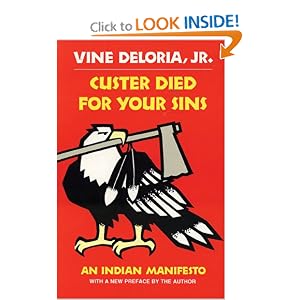
Custer Died For Your Sins, by Vine Deloria Jr.

#18 for 2011


Custer Died For Your Sins, by Vine Deloria Jr. 
(1969)

-Quotes, notes, thoughts in progress...
Life on this continent and views concerning it were not shaped in a post-Roman atmosphere.  The entire outlook of the people was one of simplicity and mystery, not scientific or abstract.  The western hemisphere produced wisdom, western Europe produced knowledge.  (p.18)
x
Some tribes keep their rituals and others don't.  The best characterization of tribes is that they stubbornly hold on to what they feel is important to them and discard what they feel is irrelevant to their current needs.  Tradition dies hard and innovation comes hard.  Indians have survived for thousands of years in all kinds of conditions.  They do not fly from fad to fad seeking novelty.  That is what makes them Indian.  (p.23)
x
Three books, to my way of thinking, give a good idea of the intangible sense of reality that pervades the Indian people.  When the Legends Die by Hal Borland gives a good picture of Indian youth.  Little Big Man by Thomas Berger gives a good idea of Indian attitudes toward life.  Stay Away, Joe, by Dan Cushman, the favorite of Indian people, gives a humorous but accurate idea of the problems caused by the intersection of two ways of life.  Anyone who can read, appreciate, and understand the spiritual forces brought out in these books will have a good idea of what Indians are all about.  (p.23)
On my list...
"What," people often ask, "did you expect to happen?  After all, the continent had to be settled, didn't it?"

We always reply, "Did it?" And continue, "If it did, did it have to be settled in that way?"  For if you consider it, the continent is now settled and yet uninhabitable in many places today.  (p. 55)
x
America has always been a militantly imperialistic world power eagerly grasping for economic control over weaker nations.  The Indian wars of the past should rightly be regarded as the first foreign wars of American history.  As the United States marched across this continent, it was creating an empire by wars of foreign conquest just as England and France were doing in India and Africa.  Certainly the war with Mexico was imperialistic, no more or less than the wars against the Sioux, Apache, Utes, and Yakimas.  In every case the goal was identical:  land.

When the frontier was declared officially closed in 1890 it was only a short time before American imperialistic impulses drove this country into the Spanish-American War and the acquisition of America's Pacific island empire began.  The tendency to continue imperialistic trends remained constant between the two world wars as this nation was involved in numerous banana wars in Central and South America.

There has not been a time since the founding of the republic when the motives of this country were innocent.  Is it any wonder that other nations are extremely skeptical about its real motives in the world today?  (p.57)
Speaking in 1969 (about Vietnam in particular) but applicable in every aspect still today and for all the foreseeable future as well.

Into each life, it is said, some rain must fall....  But Indians have been cursed above all other people in history.  Indians have anthropologists.  (p.83)
x
The explanation of the book [Man's Rise to Civilization as shown by the Indians of North America from Primeval Times to the Coming of the Industrial State, by Farb], as found on the jacket, indicates sufficiently the assumptions under which the book was written.  In the foreword, by Elman R. Service, Professor of Anthropology at Michigan, it is noted that "beginning with the most pitiful and primitive Indians found by explorers, the Digger Indians of Nevada and Utah, Mr. Farb shows that even they are much above the highest non-human primate."  Thank you, Mr. Farb, we were pretty worried about that. (p.100)
x
One classic statement [from the above]- "Modern American society has little place for institutionalized rites of rebellion, because it is a democratic society; it is characteristic of a democratic society always to question and challenge, never to be certain of itself"- blithely dismisses social reality.

American society has, in face, institutionalized rebellion by making it popular.  Once popularized, rebellions become fads and are so universalized that not to be rebellious is to be square, out of it, irrelevant.... [In America] Unless a man is rebelling, he is not really a man.  And to achieve relevance in American society a person must always be the pioneer, the innovator, against the establishment.
Democratic society is always absolutely sure of itself.  It could not be otherwise, for the be unsure would call into question the very basis of the political institutions which gave it existence.  Even more horrifying would be an examination of the economic realities underlying the society.  (pp.101-102)
x
For the time is coming when middle class America will become credit-card-carrying, turnpike-commuting, condominium-dwelling, fraternity-joining, churchgoing, sports-watching, time-purchase-buying, television-watching, magazine-subscribing, politically inert transmigrated urbanites, who, through the phenomenon of the second car and the shopping center have become golf-playing, wife-swapping, etc etc etc suburbanites.  Or has that dawned?  If so, you will understand what has been happening to Indian communities for a long, long time.  (p.103 )
x
For the wheel of Karma grinds slowly but it does grind finely.  And it makes a complete circle.  (p.104)
x
At one time or another slavery, poverty, and treachery were all justified by Christianity as politically moral institutions of the state.  Economic Darwinism, the survival of the fittest businessman, was seen as a process approved by God and the means by which He determined His Chosen for salvation.... Few mastered the harp before departing for that better life, however.  (p.108)
x
The Great Spirit was exchanged for Santa Claus with some misgivings.  Substituting toys for spiritual powers created a vacuum, however, and the tribes secretly preferred their old religion over the religion of the Easter Bunny.  (p.113)
 x
Christianity has proved to be a disintegrating force by confining its influence to the field of formula recitation and allowing the important movements of living go their separate ways until life has become separated into a number of unrelated categories.

Religion today, or at least Christianity, does not provide the understanding with which society makes sense.  Nor does it provide any means by which the life of the individual has value.  Christianity fights unreal crises which it creates by its fascination with its own abstractions. (p.122)
x
Pages 122-123, death, esp:
When it is suppressed- as it is in the Christian religion- death becomes an entity in itself and is something to be feared.  But death also becomes unreal and the act of an arbitrary God.  When death is unreal, violence also becomes unreal, and human life has no value in and of itself. (p.123)

More, less, or no responsibility is irrelevant to the problem.  When we talk about ["giving"] responsibility, in these terms we are talking about play acting.  Responsibility can never be given unless it is welcome and desired.  I could no more give my children responsibility than I could give them the far side of the moon.  They must have a real status and stake in the process or they will recognize my overtures as tricks.  (p.145)
There is no real freedom without responsibility, and no responsibility without real freedom.
The more desperate the problem, the more humor is directed to describe it.  Satirical remarks often circumscribe problems so that possible solutions are drawn from the circumstances that would not make sense if presented in other than a humorous form.  (p.149)
x
When a people can laugh at themselves and laugh at others and hold all aspects of life together without letting anybody drive them to extremes, then it seems to me that that people can survive.  (p.168)
x
During the 1964 elections Indians were talking in Arizona about the relative positions of the two candidates, Johnson and Goldwater.  A white man told them to forget about domestic policies and concentrate on the foreign policies of the two men.  One Indian looked at him coldly and said that from the Indian point of view it was all foreign policy.  (p.157)
x
For Indians to continue to think of their basic conflict with the white man as cultural is the height of folly.  The problem is and always has been the adjustment of the legal relationship between the Indian tribes and the federal government, between the true owners of the land and the usurpers. ....

It is foolish for a black to depend upon a law to make acceptance of him by the white possible.  Nor should he react to the rejection.  His problem is social, and economic, and cultural , not one of adjusting the legal relationship between the two groups.  (pp.174-175)
x

Before the white man can relate to others he must forgo the pleasure of defining them.  (p.175)
x
When we begin to talk of Civil Rights, therefore, it greatly confuses the issue and lessens our chances of understanding the forces involved in the rights of human beings.  Rather, we should begin talking about actual economic problems; and in realistic terms we are talking about land.

No movement can sustain itself, no people can continue, no government can function, and no religion can become a reality except it be bound to a land area of its own.... So-called power movements are primarily the urge of peoples to find their homeland and to channel their psychic energies through their land into social and economic reality.  Without land and a homeland no movement can survive.  And any movement attempting to build without clarifying its goals usually ends in violence, the energy from which could have been channeled toward sinking the necessary roots for the movement's existence.  (p.179)  Peoplehood is impossible without cultural independence, which in turn is impossible without a land base.  (p.180)
x
Civil Rights is a function of a man's desire for self-respect, not of his desire for equality.  The dilemma is not one of tolerance or intolerance but one of respect or contempt.  The tragedy of the early days of the Civil Rights movement is that man people, black, white, red, and yellow, were sold a bill of goods which said that equality was the eventual goal of the movement.  But no one had considered the implications of so simple a slogan.  Equality became sameness. .... In the minds of most people in 1963, legal equality and cultural conformity were identical.   (pp.179-180)
And another word bites the dust.  Oh, equality. (Coming soon to join you:  unity.)  Of course, it bit the dust a long time ago, and was resurrected as a zombie to do its master's bidding.  People are always appropriating words and distorting the meanings thereof in order to manipulate and deceive other people.


In our hearts and minds we could not believe that blacks wanted to be the same as whites... As far as we could determine, white culture, if it existed, depended primarily upon the exploitation of the land, people, and life itself. (p.180)  Blacks seemed to be saying that white society was bad, but they wanted it anyway.  (p.186)
x
Indians simply cannot externalize themselves.  Externalization implies a concern for the future.  Indians welcome the future but don't worry about it.  (p.219)
x

What, after all, is unity but the fellowship of people? ....

Indians have always rejected unity as a weapon, though a number of young Indians want unity precisely for that reason.  Most of the tribes want unity as a fellowship of equals where they can play their Indian games with a minimum of outside interference.  Indian unity is what the churches mean when they say brotherhood, but which they dare not practice.  It is what the white man seeks in his fraternities and exclusive clubs.

Like everything else, the white man has turned the idea completely inside out when he has put unity into action.  He has defined the right to be oneself as the right of exclusive privacy, never realizing that to be alone is to be dead.  (p.220-221)
x
In place of the traditional family has come the activist ["active"] family in which each member spends the majority of his time outside the home "participating".  Clubs, committees, and leagues devour the time of an individual so that family activity is extremely limited....  At best it is a standoff, with each member giving half-hearted recognition of the multitude of tribes to which the family as a conglomerate belongs.  (pp.227-228)
x
Hippies, at least as I came to understand them, had few stable clan structures.  They lived too much on the experiential plane and refused to acknowledge that there really was a world outside of their own experiences.  Experience thus became the primary criteria by which the movement was understood.  Social and economic stability were never allowed to take root.

It seemed ridiculous to Indian people that hippies would refuse to incorporate prestige and social status into their tribalizing attempts.  Indian society is founded on status and social prestige.  This largely reduces competition to interpersonal relationships instead of allowing it to run rampant in economic circles.  Were competition to be confined to economic concerns, the white conception of a person as part of the production [and consumption] machine would take hold, destroying the necessary value of man in his social sense.

With competition confined within social events, each man must be judged according to his real self, not his wealth or educational prowess.  Hence a holder of great wealth is merely selfish unless he has other redeeming qualities besides his material goods.  Having a number of degrees and an impressive educational background is prerequisite to prestige in the white world.  It is detrimental in the Indian world unless the person has the necessary wisdom to say meaningful things also.  (pp.229-230)
x

Non-Indians must understand the differences, at least as seen in Indian country, between nationalism and militancy.  Most Indians are nationalists.  That is, they are primarily concerned with development and continuance of the tribe.  As nationalists, Indians could not, for the most part, care less what the rest of society does.  They are interested in the progress of the tribe.

Militants, on the other hand, are reactionists.  They understand the white society and they progress by reacting against it.  First in their ideas is the necessity of forcing a decision from those in decision-making positions.  Few militants would be sophisticated enough to plan a strategy of undermining the ideological and philosophical positions of the establishment and capturing its programs for their own use.

Nationalists always have the option of resorting to violence and demonstrations.  Militants shoot their arsenal merely to attract attention and are left without any visible means to accomplish their goals.  Hence militancy must inevitably lead on to more militancy.  (p.237)
x
No one is going to hand over decision-making authority to people who have no base within the community other than their ability to articulate commands  (p.250) 
x
Consider the history of America closely.  Never has America lost a war.  When engaged in warfare the United States has always applied the principle of overkill and mercilessly stamped its opposition into the dust. ....  But name, if you can, the last peace the United States has won.  Victory, yes, but this country has never made a successful peace because peace requires exchanging ideas, concepts, thoughts, and recognizing the fact that two distinct systems of life can exist together without conflict.  Consider how quickly America seems to be facing its allies of one war as new enemies.  (pp.250-251)
x
The United States operates on incredibly stupid premises.  It always fails to understand the nature of the world and so does not develop policies that can hold the allegiance of people.  It then alienates everyone who does not automatically love it.  It worries about its reputation and prestige but daily becomes more vulnerable to ideologies more realistic than its own.  (p.251)
x
Ideological leverage is always superior to violence.  People are always open to ideas even though they may appear to reject thought itself.  (p.251)
Then there is hope yet!

Tribalism looks at life as an undifferentiated whole.  Distinctions are not made between social and psychological, educational and historical, political and legal.  The tribe is an all-purpose entity which is expected to serve all areas of life.  (p.259)
x

Consider what he said on page 83:  "Churches possess the real world" and combine it with what he said on page 270:  "I have no realistic hopes that the churches will become real." 

The church as an organization is real, it has real power in the world.  But the religion itself isn't "real", the culture it fosters isn't "real", and nothing about it encourages people to deal with the real world- rather the opposite.  It encourages people to "abide" this world and set all their hopes and sights on the afterlife, because to the church, that's what's "real". 

Pages 203, 216 leadership, flexibility on issues, insistence on indirect action, general consensus, silent understandings.

Page 234, compensation instead of retribution in criminal law, Bill of Rights as stifling.
-
You should read this book.

You should also read this:  http://en.wikipedia.org/wiki/Vine_Deloria