Saturday, October 30, 2010

The Autobiography of Alice B. Toklas, by Gertrude Stein

The Autobiography of Alice B. Toklas, by Gertrude Stein

I knew of Gertrude Stein's poetry (which is the only poetry ever and always to give me a headache), but was unaware she also wrote novels, plays, operas. That she lived in Paris. That she had a medical education from John Hopkins. That her best friend was Pablo Picasso. She knew pretty much everyone who was anyone, and, though I find her personality or something about her inner self to be abrasive and off-putting, her life and her thoughts are very interesting.

And yes, she wrote this "autobiography" of her friend of twenty-five years as a way of writing her own without having to really write her own, because the concept of doing this amused her. anyway...

I will have to look up some of her other work and see how I like it. Or at least how I might be able to use it. I found this book at a library sale quite by accident. I'm glad I read this before her other work and I wish I'd read it before any of her poetry!
___
[of Matisse:] Every morning he painted, every afternoon he worked at his sculpture, late every afternoon he drew in the sketch classes from the nude, and every evening he played his violin. (p. 38)
I'm not sure which is the greater dream of mine: to be so organized, or to have so much time to myself!
As she always says of herself, she has a great deal of inertia and once started keeps going until she starts somewhere else. (p. 82)
That sounds a little strange but I think it's very true- the part about starting somewhere else. Or at least I can relate. I don't really ever stop one thing simply by stopping it, but instead and only by starting something else. This goes back to Shostakovich's saying that you can't find a fresh approach, it has to find you, and it can only find you when you have a fresh (new) approach to your life- ie, when you stop doing what you have been doing, and start something (or somehow) else.
She always says that americans can understand spaniards. That they are the only two western nations that can realise abstraction. That in americans it expresses itself by disembodiedness, in literature and machinery, in Spain by ritual so abstract that it does not connect itself with anything but ritual. (p. 91)
Disembodiedness as abstraction. Yes, perfect- and something I must think about more, because I feel something rumbling around in my subconscious in response to this.
But Henry McBride was firm, the best that I can wish you, he always said, is to have no success. It is the only good thing. He was firm about that. (p. 122)
Another point I agree with completely and hope to keep in mind.
Haweis had been fascinated with what he had read in manuscript of The Making of Americans. He did however plead for commas. Gertrude Stein said commas were unnecessary, the sense should be intrinsic and not have to be explained by commas and otherwise commas were only a sign that one should pause and take breath but one should know of oneself when one wanted to pause and take breath. (p. 132)
That is the main aspect of her writing that I noticed in this book: commas, or the lack of them.
How often I have heard her then and since explain that americans are republicans living in a republic which is so much a republic that it could never be anything else. (p. 152)

The maid at the hotel took great interest in my knitting for the soldiers. She said, of course madame knits very slowly, all ladies do. But, said I hopefully, if I knit for years may I not come to knit quickly, not as quickly as you but quickly. No, said she firmly, ladies knit slowly. As a matter of fact I did come to knit very quickly and could even read and knit quickly at the same time. (p. 165)

What a consolation- and inspiration! To think that I could learn to crochet or even knit and still be able to read at the same time! Woo, now I am even more encouraged to practice at crocheting.

[Said Gertrude Stein of a draft of Hemingway's novel:] There is a great deal of description in this, she said, and not particularly good description. Begin over again and concentrate, she said. (p. 213)
Something I need to keep in mind when I write. This novel, and that paragraph, made some of my mistakes as well as my purpose and ability as a writer much clearer to me. Let's hope it sticks.
As she used to explain to Virgil, the Catholic Church makes a very sharp distinction between a hysteric and a saint. The same thing holds true in the art world. There is the sensitiveness of the hysteric which has all the appearance of creation, but actual creation has an individual force which is an entirely different thing. (p. 228)

This is incredibly true. I have seen so many people (and sadly when I was younger I was included sometimes in that number) who think that simply being oversensitive and over reactive is a sign of the genius within or some such nonsense. No. Genius is not tied to drama but to one's own personal power, and personal power is evidenced by being solid and steadfast in what one has to face and courageous in what chooses to do- the exact opposite of the timid and insecure tendency towards hysterics.

Gertrude Stein says that if you are way ahead with your head you naturally are old fashioned and regular in your daily life. And Picasso adds, do you suppose Michael Angelo would have been grateful for a gift of a piece of renaissance furniture, no he wanted a greek coin. (p. 246)
Yes, I often wonder at the nihilism of the modern age, where people have to reinvent the wheel at every turn, just to prove they can do it, I suppose. My own tendency towards old fashioned things these days has nothing to do with me getting older, you see. Not at all. Seriously though, I look more at the really old, and original, ways of doing things- not just the ways I grew up with which are now considered by some to be old fashioned.

(There is a lovely mentioning of the subject of hats on page 14.)
___
I read this book from Thursday 21st until Thursday October 28th.

Wednesday, October 20, 2010

Born To Run, by Christopher McDougall: 3.5 stars


Born To Run, by Christopher McDougall

(eta: I just realized that I went from Of Woman Born, to Born to Run, and completely by coincidence as I got my hands on this one quite by surprise.)

Let's see- I started this one on Saturday, the 16th, and finished it last night, the 19th. Tracking down a mythical people who have kept their traditions alive well into the modern age, and realizing how much there is to learn from them? So much so that you can redefine yourself in a completely empowering way? I really enjoyed it. It inspires me. (Never mind the excitement of extreme sports and a few simply amazing races.)

I've always had problem feet. I've been in pain from my feet for as long as I can remember, even back when I was a little kid. I've tried to compensate for that or help that with all kinds of orthotics and special shoes and gimmicks and gadgets. But after reading this, I'm realizing all these things just made my problems worse. (The only thing I've tried that made a positive difference was doing toe exercises- basically, the opposite of stuffing my feet into ever more cushioning and confining spaces.) After reading this, I'm convinced I know not only how to ease the pain, but heal my feet completely, and also my knees, and lower back, and the headaches as well. And then I can get out there and move freely again. To maybe even run, myself. A wild thought!

But this story is not just about feet, or running.

Our modern feet are much like our modern selves: they ache because they are out of touch, and the more they hurt themselves overcompensating to re-establish that connection, the more we cut them off from the thing that would heal them, and the more they keep overcompensating and hurting themselves. We need to have some faith in ourselves- in and of ourselves- and reconnect with our roots and our world- because sometimes our technology causes our problems instead of healing them, exacerbates our problems instead of mitigating them.
___
He seemed to live off the land when he ran, depending on korima, the cornerstone of Tarahumara culture. Korima sounds like karma and functions the same way, except in the here and now. It's your obligation to share whatever you can spare, instantly and with no expectations: once the gift leaves your hand, it was never yours to begin with. (p. 37)
This reminds me of the quote from Faded Sun where it is said that one never gives up what one needs in/to the desert, because the desert will never give it back. This is the other side of that same coin: never give away what you need, but never hold on to what you can spare. Most of my life I've freely given away... everything. I don't have a problem with giving away. But I did have a problem with holding on to what I need. Seeing how the two concepts are related and intertwined- By holding on to everything that I need, I am free to give everything else away; by giving away what I can spare, I am able to hold on to everything I need- somehow just made it click for me.

He turned around and trotted back down. "Okay, man, lesson one. Get right behind me." He started to jog, more slowly this time, and I tried to copy everything he did. My arms floated until my hands were rib-high; my stride chopped down to pitty-pat steps; my back straightened so much I could almost hear the vertebrae creaking.

"Don't fight the trail," Caballo called back over his shoulder. "Take what it gives you. If you have a choice between one step or two between rocks, take three." Caballo has spent so many years navigating the trails, he's even nicknamed the stones beneath his feet: some were ayudantes, the helpers which let you spring forward with power; others are "tricksters," which look like ayudantes but roll treacherously at takeoff; and some are chingoncitos, little bastards just dying to lay you out.

"Lesson two," Caballo called. "Think Easy, Light, Smooth, and Fast. You start with easy, because if that's all you get, that's not so bad. Then work on light. Make it effortless, like you don't give a shit how high the hill is or how far you've got to go. When you've practiced that for so long that you forget you're practicing, you work on making it smoooooooth. You won't have to worry about the last one- you get those three, and you'll be fast."

I kept my eyes on Caballo's sandalled feet, trying to duplicate his odd, sort of tippy-toeing steps. I had my head down so long, I didn't even notice at first that we'd left the forest. (pages 110-111)
Running, Life, same thing...
[T]here was never anything wrong with Jenni that couldn't be fixed by what's wright with Jenni. (p. 200)
Back straight
Knees bent and driving forward
Heels flicking back (p. 213)
[I]t's easy to get outside yourself when you're thinking about someone else. /Scott Jurek (p. 253)
And a note on Charles Bukowski/ Dharma Bums on page 145.
___
A note on journalism:

The style of writing (in this book) is much like a magazine article, which is to be expected as the author is a journalist, having worked for the Associated Press and Runner's World magazine, etc. There tends to be more flash and sparkle with journalistic writing than I care for. I don't need to be continually impressed and enticed from word to word, sentence to sentence, with invented drama or hype. I'm looking for the story itself, the coherency of the writing, the connection to the people/subject I'm reading about, to pull me along. And yet, these journalistic kind of books are very popular and well-liked by many for the same reasons they put me off: being snarky, sensationalistic, and self-indulgent. And yes I'm putting Animal, Vegetable, Miracle and Woman: An Intimate Geography squarely in that camp. (Also, Early Spring, if you're familiar with that one.)

I really can't stand it. I really, really can't stand it. Well, maybe I can stand it from Dave Barry or Erma Bombeck or Lewis Grizzard, but they write satire and humor. Somehow that's different. You're not supposed to take them seriously- they're being ridiculous; and they're poking fun at themselves as often as at their (additional) subject matter. But with the others, I'm sorry, I didn't pick up those books to be overwhelmed with waves of their oh so obvious talent. If they'd just tell the story without all the tricks that are supposed to keep me reading, maybe their talent (or lack thereof) would speak for itself.

Meh.

That being said, this book, though it read more like a magazine, was very enjoyable. The writing wasn't so full of self-importance that it overrode the story being told. A rare feat, McDougall!

And this story is well worth the read.

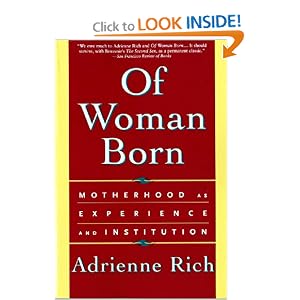
Of Woman Born, by Adrienne Rich


Of Woman Born, by Adrienne Rich


Patriarchy is the power of the fathers: a familial-social, ideological, political system in which men- by force, direct pressure, or through ritual, tradition, law, and language, customs, etiquette, education, and the division of labor, determine what part women shall or shall not play, and in which everywhere the female is subsumed under the male. It does not necessarily imply that no woman has power, or that all women in a given culture may not have certain powers. (p. 40)

Under patriarchy, I may live in purdah or drive a truck; I may raise my children on a kibbutz or be the sole bread-winner for a fatherless family or participate in a demonstration against abortion legislation with a baby on my back; I may work as a "barefoot doctor" in a village commune in the People's Republic of China, or make my life on a lesbian commune in New England; I may become a hereditary or elected head of state or wash the underwear of a millionaire's wife; I may serve my husband his early morning coffee within the clay walls of a Berber village or march in an academic procession; whatever my status or situation, my derived economic class, or my sexual preference, I live under the power of the fathers, and I have access to only so much of privilege or influence as the patriarchy is willing to accede to me, and only for so long as I will pay the price for male approval. And this power goes much further than laws or customs; in the words of the sociologist Brigitte Berger, "until now a primarily masculine intellect and spirit have dominated in the interpretation of society and culture- whether this interpretation is carried out by males or females... fundamentally masculine assumptions have shaped our whole moral and intellectual history." (p. 41)

Again: some combination or aspect of patriarchal values prevails, whether in an Orthodox Jewish family where the wife mediates with the outer world and earns a living to enable the husband to study Torah;or for the upper-class European or Oriental couple, both professionals, who employ servants for domestic work and a governess for the children. They prevail even where women are the nominal "heads of households". For, much as she may act as the co-equal provider or so-called matriarch within her own family, every mother must deliver her children over within a few years of their birth to the patriarchal system of education, of law, of religion, of sexual codes; she is in fact expected to prepare them to enter that system without rebelliousness or "maladjustment" and to perpetuate it in their own adult lives. (pages 44-45)


Wow.

I'll admit there are some parts that just lost me- I don't see how the quotes fit in etc. - and I'm not sure if it's me or what. But then there are some brilliant passages. Definitely worth reading for those (and how she expands on them). It's nice to see her take on some of the other feminist writers, too, for what it's worth.

>re: Motherhood and Daughterhood

...whatever our rational forgiveness, whatever the individual mother's love and strength, the child in us, the small female who grew up in a male-controlled world, still feels, at moments, wildly unmothered. When we can confront and unravel this paradox, this contradiction, face to the utmost in ourselves the groping passion of that little girl lost, we can begin to transmute it, and the blind anger and bitterness that have repetitiously erupted among women trying to build a movement together [or just living life] can be alchemized. Before sisterhood, there was the knowledge- transitory, fragmented, perhaps, but original and crucial- of mother-and-daughterhood. (p. 226)

Few women growing up in patriarchal society can feel mothered enough; the power of our mothers, whatever their love for us and their struggles on our behalf, is too restricted. And it is the mother through whom patriarchy early teaches the small female her proper expectations. The anxious pressure of one female on another to conform to a degrading and dispiriting role can hardly be termed "mothering", even if she does this believing it will help her daughter to survive.

Many daughters live in rage at their mothers for having accepted, too readily and passively, "whatever comes." A mother's victimization does not merely humiliate her, it mutilates the daughter who watches her for clues as to what it means to be a woman. Like the traditional foot-bound Chinese woman, she passes on her own affliction. The mother's self-hatred and low expectations are the binding-rags for the psyche of the daughter. (pages 246-247)

"I have always gotten more support from men than from women": a cliche of token women, and an understandable one, since we do identify gratefully with anyone who seems to have strengthened us. But who has been in a position to strengthen us? .... Men have been able to give us power, support, and certain forms of nurture, as individuals, when they chose; but the power is always stolen power, withheld from the mass of women in patriarchy. And, finally, I am talking here about a kind of strength which can only be one woman's gift to another, the bloodstream of our inheritance. Until a strong line of love, confirmation, and example stretches from mother to daughter, from woman to woman across the generations, women will still be wandering in the wilderness. (p. 249)


The double messages need to be disentangled. "You can be anything you really want to be" is a half-truth, whatever a woman's class or economic advantages. We need to be very clear about the missing portion, rather than whisper the fearful subliminal message: "Don't go too far." A female child needs to be told, very early, the practical difficulties females have to face in even trying to imagine "what they want to be." ....

"You can be anything you really want to be"- if you are prepared to fight, to create priorities for yourself against the grain of cultural expectations, to persist in the face of misogynist hostility. Interpreting to a little girl, or to an adolescent woman, the kinds of treatment she encounters because she is female, is as necessary as explaining to a nonwhite child reactions based on the color of her skin.

It is one thing to adjure a daughter, along Victorian lines, that her lot is to "suffer and be still," that woman's fate is determined. It is wholly something else to acquaint her honestly with the jeopardy all women live under in patriarchy, to let her know by word and deed that she has her mother's support, and moreover, that while it can be dangerous to move, to speak, to act, each time she suffers rape- physical or psychic- in silence, she is putting another stitch in her own shroud. (pages 251-252)


In the interstices of language lie powerful secrets of the culture. Throughout this book I have been thrown back on terms like "unchilded", "childless", or "child-free"; we have no familiar, ready-made name for a woman who defines herself, by choice, neither in relation to children nor to men, who is self-identified, who has chosen herself. "Unchilded", "childless" simply define her in terms of a lack; even "child-free" suggests only that she has refused motherhood, not what she is about in and of herself. (p. 253)


That is an issue for me. I have for quite a while been tired of being Wo-Man or Fe-Male and I am no longer a girl. I am not merely a wife or a mother or a daughter. Why have we no word? Besides Person which implies that you have no gender whatsoever and so is false. (woman, btw, comes from wif-man, meaning literally wife of man where man means person. so wife of a person. because women weren't persons.)

Ha, she did mention Tellurian, which is so obscure or obsolete that I didn't think anyone else knew it but me and some other nerdy people. It means "of the earth" and I guess if I HAVE to be defined in relation to something, I'd rather it be the earth. But, yeah, still, for now my name will have to do. Minus the patronymic. (Mia MoonRaven doesn't work for me either.)


>Yet ironically, precisely because they were not bound to the cycle of hourly existence with children, because they could reflect, observe, write, such women in the past have given us some of the few available strong insights into the experience of women in general. Without the un-acclaimed research and scholarship of "childless' women, without Charlotte Bronte (who died in her first pregnancy), Margaret Fuller (whose major work was done before her child was born), without George Eliot, Emily Bronte, Emily Dickinson, Christina Rossetti, Virginia Woolf, Simone de Beauvoir- we would all today be suffering from spiritual malnutrition as women.

The "unchilded" woman, if such a term makes any sense, is still affected by centuries-long attitudes- on the part of both women and men- towards the birthing, child-rearing function of women. Any woman who believes that the institution of motherhood has nothing to do with her is closing her eyes to crucial aspects of her situation.

Many of the great mothers have not been biological. ... For centuries, daughters have been strengthened and energized by nonbiological mothers, who have combined a care for the practical values of survival with an incitement towards further horizons, a compassion for vulnerability with an insistence on our buried strengths. It is precisely this that has allowed us to survive; not our occasional breakthroughs into tokendom, not our "special cases", although these have been beacons for us, illuminations of what ought to be. (pages 256-257)


>Mothering and nonmothering have been such charged concepts for us, precisely because whichever we did has been turned against us.

To accept and integrate and strengthen both the mother and the daughter in ourselves is no easy matter, because patriarchal attitudes have encouraged us to split, to polarize, these images, and to project all unwanted guilt, anger, shame, power, freedom, onto the "other" woman. But any radical vision of sisterhood demands that we reintegrate them. (p. 257)


I know no woman- virgin, mother, lesbian, married, celibate- whether she earns her keep as a housewife, a cocktail waitress, or a scanner of brain waves- for whom her body is not a fundamental problem: its clouded meaning, its fertility, its desire, its so-called frigidity, its bloody speech, its silences, its changes and mutilations, its rapes and ripenings. (p. 290)


[Women], in the solitary confinement of a life at home enclosed with young children, or in the struggle to mother them while providing for them single-handedly, or in the conflict of weighing her own personhood against the dogma that says she is a mother, first, last, and always. .... the mothers, if we could look into their fantasies- their daydreams and imaginary experiences- we would see the embodiment of rage, of tragedy, of the overcharged energy of love, of inventive desperation, we would see the machinery of institutional violence wrenching at the experience of motherhood. (p. 285)


"My children cause me the most exquisite suffering of which I have any experience. It is the suffering of ambivalence: the murderous alternation between bitter resentment and raw-edged nerves, and blissful gratification and tenderness... Sometimes I seem to myself, in my feelings toward these tiny guiltless beings, a monster of selfishness and intolerance... And yet at other times I am melted with the sense of their helpless, charming, and quite irresistible beauty- their ability to go on loving and trusting- their staunchness and decency and unselfconsciousness. I love them."

- from Adrienne Rich's journal as a young mother, from the back cover

Wednesday, October 6, 2010

Regenesis, by C.J. Cherryh

Regenesis by C.J. Cherryh

Mind-boggling.

I was going to reread Cyteen first, and then go straight into Regenesis. But something at the last moment urged me to just read Regenesis first. I think that was the better choice. And I think it was wise to wait this long dreadful wait before reading it, so that some of my excitement could temper a bit.

Cyteen is a seminal work, and written decades ago- Regenesis (its sequel) is not supposed to be exactly like Cyteen, or a mere continuation. I will say so, at least. I like it for what it is, and I'm glad I gave myself a chance to understand it on its own.

After that foray into the birthlabs etc, I'm starting Adrienne Rich's Of Woman Born (an irresistible juxtaposition). I hope to reread Cyteen (and Regenesis) sometime this year to see how they do flow together, now that I'm not as likely to directly compare them.

_____

Thursday, September 30, 2010

The Faded Sun Trilogy (Kesrith, Shon'jir, Kutath) by C.J. Cherryh: 4-1/2 stars


The Faded Sun Trilogy by C.J. Cherryh

The reading of this book (these books) was well-timed for me. It was so apt and I was so engrossed that the household grew jealous of the book: my youngest tried to take it apart, and, when that failed, the cats tried to eat it on two separate occasions. But I would not be turned away, and I was well-rewarded.

Pertinent quotes for me:

"We do not despise your knowledge," said the she'pan. "We simply do not desire it." (p. 125)

He found no limit to what senses could absorb. He felt. He was not numb. He only wished to be... (p. 185)


And from the war there were also men like himself, thousands like himself, who did not know what they were, or from what world; war-born, war-oriented. War was all his life; it had made him move again and again in retreating from it, a succession of refuge creches, of tired overworked women; and then toward it, in schools that prepared him not for trade and commerce but for the front lines. His own accent was unidentifiable, a mingling of all the places he had lived. He had no place. He had for allegiance now nothing but his humanity.

And himself. (p. 322)


All, all those little lights which were suns, and some cloudy aggregates of suns, themselves reduced to dust motes by distance which reached out from himself, who was the center of the universe, and then not- an insignificance, less than the mote of a world, far less than a sun, infinitely less than the vast galaxies, and the distance, the cold, deep distance that never stopped, forever. (p. 513)


He understood one rule, that waste was death; that what one gave the desert it never gave back, to world's end.

He did what he knew to do, which was yield nothing. (p. 571)


Of course, the meaning is to yield nothing that you need, which is implied since the he is of a kind that do not encumber themselves with anything but what is needed- the absolute bare minimum. Determine what that is, hold it to you, and never, no matter what, let it go. Let everything else in the world go, freely and without grief, but never what you need.

Time was not... like beads on a string, event and event and event, from which Darks could sever them, breaking the string. There was only the Now, which extended and embraced all the Past which she contained and the pan'en contained, and all the past which had brought Kutath to this moment; and all the future toward which she led.

She was not single, but universal; she inhaled the all and breathed it through her pores. She Saw, and directed, and it was therefore necessary to do very little, for from the Center, threads ran far. It was that, to believe in one's own Sight. There was no anger, for nothing could cross her. There was no true pride, for she was all-containing. (p. 594)


Humans[,] accustomed to the factual instabilities of their perceptions, even lied, which was to give deliberate inaccuracy to memory, past or future. They existed in complete flux; their memories periodically purged themselves of facts: this was perhaps a necessary reflex in a species which remembered things that had not yet happened and which falsified what had occurred or might occur. (p. 603)

Saturday, September 25, 2010

Testimony: The Memoirs of Dmitri Shostakovich as related to and edited by Solomon Volkov, 5 stars


I know there is a lot of controversy about this book. Whether or not you are inclined to believe it, the work is marvelous nonetheless. And there is truth in it, profound truth, lasting truth- even if you consider the book to be a work of fiction.

This is definitely going in my permanent library.

How can you complain that it's hard to find a "fresh approach"? What is it, a wallet full of money? Can you find a "fresh approach" walking down the street- someone drops it and you pick it up? .... [Y]ou can't find a fresh approach; it has to find you. A fresh approach to music, as I have seen time and time again, usually come to those who have a fresh approach to other aspects of life, to life in general. (p. 72)


At least, it always seems that everything is different today from what it was yesterday. And it will all be different tomorrow. No one knows how, but it will be different. (p. 108)


When he was talking about torture, including the torture of animals, this phrasing caught my attention:
I see a desire to drag animals down to the level of man, so that they can be dealt with like men. (p. 124)

He deals quite a bit with the treatment of the Jews. There is little humor in it, except in this passage, which is simply so absurd:

Recently I went to the Repino station to buy a lemonade. There's a little store, a stall really, that sells everything. There was a line, and a woman in the line, who looked very Jewish and had an accent, began to complain out loud. Why is there such a line, and why are canned peas only sold with something else, and so on.

And the young salesman answered along these lines: "If you're unhappy here, citizeness, why don't you go to Israel? There are no lines there and you can probably buy peas just like that."

So Israel was pictured in a positive way, as a country without lines and with canned peas. And that's a dream for the Soviet consumer, and the line looked with interest at the citizeness who could go to a country where there are no lines and more peas than you could want. (p. 158)


Ah, and it was mentioned that in a backlash against the West, French bread was renamed "city" bread. Everyone is always renaming food to show their disdain for those poor French. (p. 173)

Advice with sardonic insight:
Don't try to save humanity all at once, try saving one person first. It's a lot harder. To help one person without harming another is very difficult. It's unbelievably difficult. That's where the temptation to save all of humanity comes from. And then, invariably, along the way you discover that all humanity's happiness hinges on the destruction of a few hundred million people, that's all. A trifle. (p. 205)


The event described on pages 214-215 is quite horrible, beyond words. And yet it happened.

On censorship:
Soviet man has withstood everything: hunger, and destruction, and wars - one worse than the other- and Stalin's camps. But he won't be able to take that chapter from The Possessed, he'll crack. (p. 269)

Wednesday, September 22, 2010

Edible Estates: Attack on the Front Lawn, by Fritz Haeg , Diana Balmori, Rosalind Creasy


Edible Estates: Attack on the Front Lawn, by Fritz Haeg , Diana Balmori, Rosalind Creasy

For if lawn mowing feels like copying the same sentence over and over, gardening is like writing out new ones, an infinitely variable process of invention and discovery.

/Michael Pollan, Why Mow? (p. 35)


Wonderful book. Especially if you are American.

Friday, September 17, 2010

Innerfar by Gerhard Kopf


Innerfar by Gerhard Kopf

Actually the book I have contains both Innerfar and Bluff, or Southern Cross, by Gerhard Kopf. But I’m going to read a library book before I get back to Bluff.

To oversimplify, greatly, and to leave out the cultural significance which is everything but which I am not yet able to describe sufficiently: a once-famous poet turns up in a psychiatric hospital for dementia and schizophrenia, nobody quite realizing who she is, and nobody being able to tell when she is completely disoriented or when she has her moments of absolute clarity and insight which she often expresses in allegory, quotations, or poetic storytelling. This is juxtaposed with the narrator’s remembrances of earlier times with the poet.

The editing in this book is a bit off- sometimes they forgot periods and such, and this was in the afterword by the translator so I know it wasn’t part and parcel of the novel experience. It didn’t make too much difference, the story being so liminal; it just added to the disorientation. Still, one would think they could have attended better.

From reviews (on the linked Amazon page):

Loss and fulfillment cohabit uneasily in the novel as Kopf purposefully blurs the distinction between reality and fantasy, truth and illusion, in order to make a rather Romantic point about the redemptive powers of the imagination.

[T]he book is a search for identity through memory and storytelling.


Here are two quotes from the book that both vie to be my favorite:
Every breath taken is an omission (p. 79)

&

“Praised be the subjunctive and its knight Talander.” (p.102)

(Now I must read August Bohse, who wrote under the pen name Talander.)

and my favorite passage:

Even at the table the doctor has her notebook ready. The murmuring is mentioned as well as several times the expression: “Sausage in your eye.” Also that the patient then points in turn at the sausage slices on the plate and at her left eye, which she has closed.

She kneads false teeth out of the bread.

Carefully she makes the incisors and the jaw teeth, molds a lower jaw- the likeness is astonishing.

Suddenly and unexpectedly she shoves the creation in her mouth.

The doctor asks, writing down at the same time:
“What are you doing, Mrs. Piloti?”

“You don’t play with your food.” Nurse Angela has a serious expression on her face.

“My father always used to say that before he went to Billi. Billi, my teddy bear. But you can see what I’m doing.

I’m making a mouth shoe.”

(p. 55)


It’s a trip. At one point, I was reading such as the above (basically the whole novel is like this), and thinking how familiar it seemed somehow, when son interrupted to tell me, apropos of nothing, that a bank is a wolf house that sells money. And then I looked around at my life with a different perspective and realized why the story was so familiar after all.

But I am not disconsolate at all. That would be out of place.

Finally experience has overtaken longing. Out of the reconciliation of reality and dream she draws unending strength. (p.110)

Monday, September 13, 2010

The Handmaid’s Tale by Margaret Atwood: 4.5


The Handmaid’s Tale by Margaret Atwood

This is, indeed, a pretty amazing book.

I was young when it came out, too young to be reading novels like this, so I missed it then. I’ve heard about it, though; in fact, I can’t remember a time before I heard about it- it was always ubiquitous, in the background, taken for granted. It never therefore occurred to me to read it, because I never paid attention to it, never consciously realized it as an option.

Rather ironic, given the nature of the main character, the narrator, one who has been stripped of identity and human existence.

And given the nature of the story itself, bringing to light the cultural assumptions we don’t even realize we have- like the light bulb we never think about until it goes out, or starts flickering. It’s not as if we don’t know there is a light bulb; we just have never thought about it before, because it was always there.

“Once you learn to discern the voice of Mother Culture humming in the background, telling her story over and over again to the people of your culture, you’ll never stop being conscious of it. Wherever you go for the rest of your life, you’ll be tempted to say to the people around you, ‘How can you listen to this stuff and not recognize it for what it is?’”

Daniel Quinn, Ishmael

The Handmaid’s Tale is powerful and probing and well-done. I won’t say it’s profound- it isn’t, although the questions it raises are- but it’s very good at revealing human-ness and underlying issues. It makes you think, and pay attention.

It reminds me of Orwell’s 1984:

“Never again will you be capable of ordinary human feeling. Everything will be dead inside you. Never again will you be capable of love, or friendship, or joy of living, or laughter, or curiosity, or courage, or integrity. You will be hollow. We shall squeeze you empty and then we shall fill you with ourselves.”

but also V for Vendetta:

“Beneath this mask there is more than flesh. Beneath this mask there is an idea, Mr. Creedy, and ideas are bulletproof.”

It also brings to mind the very real stories of Nazi Germany, Soviet Russia, South Africa under Apartheid, and many others, some of which are still unfolding around us- including our own.

Our own story, the one we write, is the one we have the most say over. We should be paying more attention. Works of art like this bring culture to our attention, into a place where we can think and talk about it.

Art destroys silence. /Dmitri Shostakovich


From The Handmaid's Tale:
Not a dandelion in sight here, the lawns are picked clean. I long for one, just one, rubbishy and insolently random and hard to get rid of and perennially yellow as the sun. Cheerful and plebeian, shining for all alike. Rings, we would make from them, and crowns and necklaces, stains from the bitter milk on our fingers. (p. 275-6)


I feel this way. I don’t have the particular problem of being denied access to dandelions, as I let them grow and they will always grow if you let them. But this description, this is why I love dandelions, too. They are my favorite flower. They are free and glorious and come complete with crowns and wishes, salad and tea.

Sometimes I look around the city and am overwhelmed with the wish for dandelions everywhere- bursting forth from cracks in the sidewalks, between concrete steps, along the sides of the roads where asphalt meets the curb. Forests of dandelions, knee-high, shoulder-high, rising up, sundering all.

Sandburg wrote, “I am the grass, let me work.” The grass will bury the dead, subsume the ghosts, restore innocence to the world.

I respect the grass. (I grok grass.) But I think something wilder is needed this time around. Something that we won’t simply tame and use to our advantage, so as to feel even more like gods- something that, instead, will untame us. Slip us out of culture and dogma and back into childhood and possibility and the joy of just being human. I think we need dandelions.

Monday, September 6, 2010

A poem

They borrow books they will not buy.
They have no ethics or religions.
I wish that some kind Burbankian guy
Would cross my books with homing pigeons.


---Carolyn Wells

The Invention of Everything Else, by Samantha Hunt: 4.5 stars


The Invention of Everything Else by Samantha Hunt

Wow.

When I first heard about this book, I knew I had to get it. I mean, it’s Tesla, okay? That meets my requirements right there. But the reviews were so promising, and indeed I was so excited about it, that when it arrived in the mail, I daren’t read it, because my expectations were so high.

So it sat on my bookshelf from April 2009 until now. And yet I think that I could have opened it immediately and it would have fulfilled even the ridiculous obligations I had laid out for it then.

Nikola Tesla, Samuel Clemens, John Muir- together at a dinner party? Need there be more to keep my interest? How about a realistic sense of history, even in a fictionalized account? How about a style of writing that is at once straightforward, simple, elegant, and lyrical? Characters (besides the famous ones) that are well-developed and enchanting. A plot that continues to unfold, inevitably, even as you wish it stopped or transformed. Imaginative explorations that gave me chills.

And then THIS gem on page 240:

I didn’t care what they had said. I didn’t believe them. Who are government men to tell the truth? I held on to the file. I had sat very straight during the interview as though I was Bess the landlord’s daughter, the landlord’s black-eyed daughter with a shotgun tucked just below my rib cage, primed to go off if I exhaled too vigorously. I answered their questions, but there was very little to tell.

It made me think that, yes, this book reminded me of that poem (Alfred Noyes's The Highwayman), and that song (sung by Loreena McKennitt)- indeed, the feeling one gets from reading this book is not unlike that of listening to a ghost story.

And yet, as magical and otherworldly as it might seem at times, it is still grounded- any good story about Tesla would have to be both. He may be a ghost, but he’s just as real in death as he was fantastical in life.

“[T]here is only one world. This one. The dream is real. The ordinary is the wonderful. The wonderful is the ordinary.” (p. 84)

And, indeed, if you don't understand this, you will not understand the book. It will go right over your head.

I've found the right word, and the reason why I kept thinking about Marilynne Robinson's work in comparison (in addition to Kafka's [Amerika], which could almost *be* the story of Tesla, poor soul):

Ethereal

What was it to suddenly come awake? To suddenly fall asleep? Particularly while Freddie was standing there just beside him? What would she think of him if he were to stretch out underneath one of the pine massifs that are not really pine massifs but street lamps? To take off his shoes and dip his feet into a brook that might have trickled across the island of Manhattan two hundred years before but had since been staunched and subverted by culverts, bubbling up as a filthy puddle, a sparrow's oily bathtub? What was it to suddenly come awake? It was terrifying. Yes, he thought. I am terrified, but I don't want it to end. If time is so porous that a full-grown man can slip inside it while holding fast to the hand of his wife, what then can he rely on at all? The solidity of a hand? He doubted it. (pp. 102-3)


Oh, yes. Ethereal is the perfect word for this book.

Saturday, September 4, 2010

The Argument Culture: Stopping America’s War of Words, by Deborah Tannen: 2-1/2 stars


The Argument Culture: Stopping America’s War of Words by Deborah Tannen

Preaching to the choir. Only she’s much less skeptical about the intentionality of it all, at least on certain levels, than I am.

And goodness, but so many words to say this. Repetitive and not really all that illuminating.

I know; I sound very critical, and after reading this book I should be more collaborative or supportive or what have you. I actually agree with much of what she says, which is why I shouldn't feel like I had to wade through all of that, like it was more of an obligation than a free pursuit.

I guess if you have no idea what she is talking about, or if your first response to the idea of America as being rife with antagonism is a reflexive denial or dismissal, then this is the book for you.

Wednesday, September 1, 2010

The Professor and the Madman: A Tale of Murder, Insanity, and the Making of the Oxford English Dictionary by Simon Winchester


The Professor and the Madman: A Tale of Murder, Insanity, and the Making of the Oxford English Dictionary by Simon Winchester

This was perfect to go along with The History of the English Language which I am following right now.

You'd think these subjects would be mundane (the making of dictionaries, the history of English), but they involve humans, and humans are all batty as hell.

Monday, August 30, 2010

Legions of Hell by C.J. Cherryh


Legions of Hell by C.J. Cherryh

How could I resist a book entitled Legions of Hell?

“What are you reading this summer, Mia?”
“Oh, nothing, just LEGIONS OF HELL. Bwahahahaha!

I can’t really pull of an evil laugh, though, which sort of makes it pointless. ;)

Anyway the story is not about Hell as the Big Three tend to portray it, with lakes of boiling fire and demons with pitchforks and all that. It’s different, and more subtle. Don’t worry, however; with Hatshepsut, Ramses II, Niccolo Machiavelli, Napoleon Bonaparte, Lawrence of Arabia, and the Roman Emperors involved, how could it be anything less than interesting?

---oh, and Augustus means it, Lion, he always means such things. And will mean them to the day some offense inflames him, then, then, he strikes without a qualm. There is no liar, Lion, like a sincere and reasoning man. (p. 33)

The wording is sharp and distinct as ever: She had died the focus of heroic fools. (p. 42)

Think, Niccolo was wont to tell him, when that sinister man offered him advice. Learn everything. That, boy, is the only way to know what you dare discard. Even to know that a thing is useless, is to know the value of everything. (p. 185)

It also involves the best and most unexpected cameo ever, when Caesarion and Marcus Junius Brutus run into an unnamed man on the subway of New Hell (page 221):

“I m-m-missed the station.”

“That’s all right,” Caesarion said. You can catch it next time around. We’re getting off at the next stop. Just stay put.”

“C-c-catch it next time. Yes. Yes.” The gray man bobbed his head up and down, clinging to the seat back with Caesarion’s gun on him. And then the gray in his eyes got grayer and paler and more desperate. “You’re going to get off. I want off. Get me out of here!

“Mister, you just stay out of our way, hear?.... Just sit down,” Caesarion told the gray man. “Sit! Read your paper! Hear?”

“I r-r-read the paper,” the gray man said. “I r-r-read the damn paper.” Tears welled up. “I g-got on this train in Boston. I t-t-try to get off- I keep trying to get off- I don’t care what stop, anymore. I don’t think this is Boston, anyway.”

Yes, that’s right, oh those in the know: Charlie on the MTA!_

BEST. CAMEO. EVER.


Share|

Wednesday, August 25, 2010

World Cultures: Russia by Stephen and Tatyana Webber


World Cultures: Russia by Stephen and Tatyana Webber

I have to move to Russia now.


Share|

Friday, August 20, 2010

The Awakening and Selected Short Stories by Kate Chopin: 5 stars


The Awakening and Selected Short Stories by Kate Chopin
with introduction by Marilynne Robinson

This is a really well-written story. I absolutely love her voice. The fact that it has an introduction by Marilynne Robinson, who is in my opinion a genius poet, was a very good sign, and well-deserved. The Awakening (or, A Solitary Soul) was published in 1899 and still speaks quite clearly to me today. The world has changed, but the questions haven’t.

This edition comes with eight other shorter works, my favorite of which (but they are all fantastic) is A Pair of Silk Stockings. (Next-favorite is Desiree’s Baby.)

I will definitely be reading more of her.


Sunday, August 15, 2010

Language Shock: Understanding the Culture of Conversation by Michael Agar: 3-1/2 stars

(Today, actually)

Language Shock: Understanding the Culture of Conversation by Michael Agar

page 66:

Whorf looked at grammar and vocabulary, noticed the differences between one language and another, and said that they were more than just arbitrary differences that let you talk about the same objective, world.

The differences make you live in a different world.

This is strong, subversive stuff. The world can’t be separated from the language used to talk about it. They’re wrapped up together like hydrogen and oxygen in water. You can’t pull them apart and still have water to drink.

Objective reality disappears in the mist. Two different languages aren’t just alternative ways to talk about the same reality. Alternative languages carry with them a different theory of what reality in fact is. A shift from one language to another is a shift between two different worlds, where speakers of each one think their version is “objective”, but they’re both wrong.


Very much like the phenomenologist Maurice Merleau-Ponty et al on intersubjectivity.

(At the core of Merleau-Ponty’s philosophy is a sustained argument for the foundational role that perception plays in understanding the world as well as engaging with the world. /Wiki)

pages 13/14:

These different ways of looking at things had come to life in our common language, and they tied in with who we were, with our different social identities. The differences happened inside the same language, just as differences do between languages as distinct as Japanese and English….

Something happened…that had to do with who we were. Something came up, jolted us with a difference, made us aware that the “natural” way of doing things wasn’t “natural” at all [but learned]....

Differences like these- the sort of misunderstandings that we usually associate with a foreign language- happen inside a language all the time.


On page 250, He talks about the term Languaculture, to drive home the point that communication is not about words, or grammar, or proper verb conjugation- but about the people who use the language, their self and social identities, and the interaction between them against a broader cultural background.
Where the langua part is:

[T]hat this noun means that thing, and this verb means that action, so that the two together mean action on this thing… Word meanings in the sense of reference, and sentence meanings in terms of propositional structure.


And the culture part is:

How those words and sentences shimmer with associations, connotations… [A] sense of how to converse, argue, and tell a lie… [A] sense of who they’re talking with, and how they see them, of how that specific moment ties in with all the others that go into the flow of daily life, of how the talk fits into the society and the currents of history that lie behind it.


page 209:

Languaculture is a social fact. It sets limits on what you can say and sets up expectations of how you’re supposed to talk. But there are people… who struggle against the limits. Their experience of culture takes shape within their own. Rich points come into consciousness and inspire new frames, frames that make a new kind of discourse possible….

The new languaculture is a way to change the world by changing what it is that can be thought, said, and done.


Native Tongues by Charles Berlitz: 4 stars

(August 12)

Native Tongues by Charles Berlitz


A few tid bits:

During World War I, anti-German feeling caused sauerkraut to be renamed “liberty cabbage”, and hamburger to be renamed “Salisbury steak”.


Would you like “Freedom fries” with that?

Sometimes an entire English sentence sounds like a basic expression in another language. Americans visiting Japan who would ordinarily experience some difficulty in remembering the Japanese term for “You are welcome” (dooitashimashite) have solved the problem simply- answering the Japanese “Thank you” (arigato) with “Don’t touch my mustache”. Said quickly, this is quite close enough to be an acceptable answer.


Now that scene in Toy Story 2 finally makes sense.

[In Mexico today] the Aztec rather than the Spanish names for certain animals are still used: “zopilote” (vulture), “tecolote” (owl), among many [including coyote]. The final “te” in these words stands for the Aztec “tl” ending, similarly modified in other words familiar to Americans, such as “chocolatl” (chocolate) and “jitomatl” (tomato).

Oh, and “California” is the name of the queen of the Amazons.

This book actually has some great information in it about which English words come from French, Latin, and German in particular, and therefore how knowing these words and recognizing patterns will help you learn other languages faster.

And though you may not care to learn Latin, perhaps, it's a small hop, skip, and jump to apply that information to learning Spanish, Italian, and even Portuguese.

People Skills by Robert Bolton: 5 stars

(July 13)

People Skills by Robert Bolton

I really like this book.

Mating: A Novel by Norman Rush: 2 stars

(July 4)

Mating: A Novel by Norman Rush

I was intrigued at the beginning, and grew more and more disturbed the further along I read. Not by the plot or the political/etc discussions or anything, but by the narrator, the main character.

Also, how the hell is this a love story?

A story detailing obsession and outrageous manipulation, yes, but love? I don’t think so.

I need to read a book that I like now. The last two came highly recommended, but sadly I pretty much hated them both.

Honestly, I thought this book, about an American woman who ends up living in a secluded social-experiment commune-esque village in Africa, would be right up my alley. Something I could relate to. Instead I can’t even relate to that. But then again, of course I cannot relate to her, I am not a quasi-psychotic narcissist.

Apparently it’s back to space aliens again.