Sunday, August 15, 2010

Selected Poems of Emily Dickinson

(June 23)

Selected Poems of Emily Dickinson
Barnes & Noble edition published 2007

I love Dickinson. Sadly, I have to agree with this review:

I don’t doubt that it’s possible to enjoy Emily Dickinson’s poems in editions like this. But you should be aware that you are not really reading what she wrote. You are reading what earlier editors wish she had written – a sort of ‘tidied-up’ and regularized version, a badly-tampered-with-text of a genius by those who weren’t.


For example, on page 85:

There’s a certain slant of light,
On winter afternoons,
That oppresses, like the weight
Of cathedral tunes.

It’s heft, not weight, and they’re not the same thing. This edition is sort of like, Dickinson Dumbed Down. :\

From the same review, and for my reference as well as yours:

There are two major editors who can be relied on for accurate texts of ED’s poems. These are Dickinson scholars R. W. Franklin and Thomas H. Johnson. Both produced large Variorum editions for scholars, along with reader’s editions of the Complete Poems for the ordinary reader. Details of their respective reader’s editions are as follows.

THE POEMS OF EMILY DICKINSON : Reading Edition. Edited by R. W. Franklin. 692 pp. Cambridge, Massachusetts : The Belknap Press of Harvard University Press, 1999. ISBN 0-674-67624-6 (hbk.)

THE COMPLETE POEMS OF EMILY DICKINSON. Edited by Thomas H. Johnson. 784 pp. Boston : Little, Brown, 1960 and Reissued. ISBN: 0316184136 (pbk.)

For those who don’t feel up to tackling the Complete Poems, there is Johnson’s abridgement of his Reader’s edition, an excellent selection of what he feels were her best poems:

FINAL HARVEST : Emily Dickinson’s Poems. Edited by Thomas H. Johnson. 352 pages. New York : Little Brown & Co, 1997. ISBN: 0316184152 (paperbound).

Friends, do yourself a favor and get Johnson’s edition. Why accept a watered-down version when you can have the real thing?


Saturday, May 15, 2010

A People's History of the United States by Howard Zinn: 5 stars


It took me a while to read through it all the way, but that's because there is so much to it. If you only read one book all year, or one book in the next fifty years, please let it be this one.

Available to read online here.

A video about it here.

Thus, in that inevitable taking of sides which comes from selection and emphasis in history, I prefer to try to tell the story of the discovery of America from the viewpoint of the Arawaks, of the Constitution from the standpoint of the slaves, of Andrew Jackson as seen by the Cherokees, of the Civil War as seen by the New York Irish, of the Mexican war as seen by the deserting soldiers of Scott's army, of the rise of industrialism as seen by the young women in the Lowell textile mills, of the Spanish-American war as seen by the Cubans, the conquest of the Philippines as seen by black soldiers on Luzon, the Gilded Age as seen by southern farmers, the First World War as seen by socialists, the Second World War as seen by pacifists, the New Deal as seen by blacks in Harlem, the postwar American empire as seen by peons in Latin America. And so on, to the limited extent that any one person, however he or she strains, can "see" history from the standpoint of others.

My point is not to grieve for the victims and denounce the executioners. Those tears, that anger, cast into the past, deplete our moral energy for the present. And the lines are not always clear. In the long run, the oppressor is also a victim. In the short run (and so far, human history has consisted only of short runs), the victims, themselves desperate and tainted with the culture that oppresses them, turn on other victims.

Still, understanding the complexities, this book will be skeptical of governments and their attempts, through politics and culture, to ensnare ordinary people in a giant web of nationhood pretending to a common interest. I will try not to overlook the cruelties that victims inflict on one another as they are jammed together in the boxcars of the system. I don't want to romanticize them. But I do remember (in rough paraphrase) a statement I once read: "The cry of the poor is not always just, but if you don't listen to it, you will never know what justice is."

I don't want to invent victories for people's movements. But to think that history-writing must aim simply to recapitulate the failures that dominate the past is to make historians collaborators in an endless cycle of defeat. If history is to be creative, to anticipate a possible future without denying the past, it should, I believe, emphasize new possibilities by disclosing those hidden episodes of the past when, even if in brief flashes, people showed their ability to resist, to join together, occasionally to win. I am supposing, or perhaps only hoping, that our future may be found in the past's fugitive moments of compassion rather than in its solid centuries of warfare.

That, being as blunt as I can, is my approach to the history of the United States. The reader may as well know that before going on. (pp. 10-11)


This makes me want to read The People, Yes again, to say, to add, Yes, the people will go on.

The use of the phrase "all men are created equal" [in the Declaration of Independence] was probably not a deliberate attempt to make a statement about women. It was just that women were beyond consideration as worthy of inclusion. They were politically invisible. Though practical needs gave women a certain authority in the home, on the farm, or in occupations like midwifery, they were simply overlooked in any consideration of political rights, any notions of civic inequality.

To say that the Declaration of Independence, even by its own language, was limited to life, liberty, and happiness for white males is not to denounce the makers and signers of the Declaration for holding the ideas expected of privileged males of the eighteenth century. Reformers and radicals, looking discontentedly at history, are often accused of expecting too much from a past political epoch- and sometimes they do. But the point of noting those outside the arc of human rights in the Declaration is not, centuries late and pointlessly, to lay impossible moral burdens on that time. It is to try to understand the way in which the Declaration functioned to mobilize certain groups of Americans, ignoring others. Surely, inspirational language to create a secure consensus is still used, in our time, to cover up serious conflicts of interest in that consensus, and to cover up, also, the omission of large parts of the human race. (pg. 72)


-
It is possible, reading standard histories, to forget half the population of the country. The explorers were men, the landholders and merchants men, the political leaders men, the military figures men. The very invisibility of women, the overlooking of women, is a sign of their submerged status.

In this invisibility they were something like black slaves (and thus slave women faced a double oppression). The biological uniqueness of women, like skin color and facial characteristics for Negroes, became a basis for treating them as inferiors. True, with women, there was something more practically important in their biology than skin color-their position as childbearers-but this was not enough to account for the general push backward for all of them in society, even those who did not bear children, or those too young or too old for that. It seems that their physical characteristics became a convenience for men, who could use, exploit, and cherish someone who was at the same time servant, sex mate, companion, and bearer-teacher-warden of his children.

Societies based on private property and competition, in which monogamous families became practical units for work and socialization, found it especially useful to establish this special status of women, something akin to a house slave in the matter of intimacy and oppression, and yet requiring, because of that intimacy, and long-term connection with children, a special patronization, which on occasion, especially in the face of a show of strength, could slip over into treatment as an equal. An oppression so private would turn out hard to uproot. (pg. 103)


From the chapter: The Intimately Oppressed. This chapter is about women in America, mostly right after the American Revolution:

Abigail Adams, even before the Declaration of Independence, in March of 1776, wrote to her husband:
Quote:
... in the new code of laws which I suppose it will be necessary for you to make, I desire you would remember the ladies, and be more generous to them than your ancestors. Do not put such unlimited power in the hands of husbands. Remember, all men would be tyrants if they could. If particular care and attention are not paid to the ladies, we are determined to foment a rebellion, and will not hold ourselves bound to obey the laws in which we have no voice of representation.
(pg. 110)


& up until the 1850s:

A series of women's conventions in various parts of the country followed the one at Seneca Falls. At one of these, in 1851, an aged black woman, who had been born a slave in New York, tall, thin, wearing a gray dress and white turban, listened to some male ministers who had been dominating the discussion. This was Sojourner Truth. She rose to her feet and joined the indignation of her race to the indignation of her sex:
Quote:
That man over there says that woman needs to be helped into carriages and lifted over ditches. .. . Nobody ever helps me into carriages, or over mud-puddles or gives me any best place. And a'nt I a woman?
Look at my arm! I have ploughed, and planted, and gathered into barns, and no man could head me! And a'nt I a woman?
I would work as much and eat as much as a man, when I could get it, and bear the lash as well. And a'nt I a woman?
I have borne thirteen children and seen em most all sold off to slavery, and when I cried out with my mother's grief, none but Jesus heard me! And a'nt I a woman?
(pg. 124)


In 1900 there were 500,000 women office workers-in 1870 there had been 19,000. Women were switchboard operators, store workers, nurses. Half a million were teachers. The teachers formed a teachers League that fought against the automatic firing of women who became pregnant. The following "Rules for Female Teachers" were posted by the school board of one town in Massachusetts:
Quote:
1. Do not get married.
2. Do not leave town at any time without permission of the school board.
3. Do not keep company with men.
4. Be home between the hours of 8 P.M. and 6 A.M.
5. Do not loiter downtown, in ice cream stores.
6. Do not smoke.
7. Do not get into a carriage with any man except your father or brother.
8. Do not dress in bright colors.
9. Do not dye your hair.
10. Do not wear any dress more than two inches above the ankle.
(pg. 339)


Charlotte Perkins Gilman, whose writing emphasized the crucial question of economic equality between the sexes, wrote a poem called "The Socialist and the Suffragist," ending with:
Quote:
"A lifted world lifts women up,"
The Socialist explained.
"You cannot lift the world at all
While half of it is kept so small,"
the Suffragist maintained.
The world awoke, and tartly spoke:
"Your work is all the same;
Work together or work apart,
Work, each of you, with all your heart-
Just get into the game!"


When Susan Anthony, at eighty, went to hear Eugene Debs speak (twenty-five years before, he had gone to hear her speak, and they had not met since then), they clasped hands warmly, then had a brief exchange. She said, laughing: "Give us suffrage, and we'll give you socialism," Debs replied: "Give us socialism and we'll give you suffrage." (pg. 342)


-
Some women radicals were skeptical. Emma Goldman, the anarchist and feminist, spoke her mind forcefully, as always, on the subject of women's suffrage:
Quote:
....
[A woman's] development, her freedom, her independence, must come from and through herself. First, by asserting herself as a personality. Second, by refusing the right to anyone over her body; by refusing to bear children, unless she wants them; by refusing to be a servant to God, the State, society, the husband, the family, etc. by making her life simpler, but deeper and richer.. . . Only that, and not the ballot, will set woman free..


And Helen Keller, writing in 1911 to a suffragist in England:
Quote:
Our democracy is but a name. We vote? What does that mean? It means that we choose between two bodies of real, though not avowed, autocrats. We choose between Tweedledum and Tweedledee.. . .

You ask for votes for women. What good can votes do when ten-elevenths of the land of Great Britain belongs to 200,000 and only one-eleventh to the rest of the 40,000,000? Have your men with their millions of votes freed themselves from this injustice?
(pg. 345)


On World War One:

Ten million were to die on the battlefield; 20 million were to die of hunger and disease related to the war. And no one since that day has been able to show that the war brought any gain for humanity that would be worth one human life. (pg. 359)


And goodness but I could go on and on and on but I will stop now. I'd rather reread the book itself!

http://www.youtube.com/watch?v=5qpm6aw5OWw

Tuesday, February 9, 2010

Since last post

which was in NOVEMBER... sigh...

I've finished The Hundred Days, Blue at the Mizzen, and 21 by Patrick O'Brian. (21 I finished the typed part; I couldn't make out much of the hand-written part, but it might have been because I was too emotional about it all ending!)

I've also read:

Life of the Beloved by Henri Nouwen
Animal, Vegetable, Miracle by Barbara Kingsolver
Making & Using Dried Foods by Phyllis Hobson
Dried Flowers by Martha E. Kraska
Roots, Shoots, Buckets, and Boots by Sharon Lovejoy
The Vegetable Gardener's Bible by Edward C. Smith
Raw Family Signature Dishes by Victoria Boutenko
Fresh by Sergei and Valya Boutenko
The Raw Gourmet by Nomi Shannon

That, I think, covers 2009. Starting in January:

Gyn/ Ecology by Mary Daly
Sweetness and Power by Sidney W. Mintz
Raw Family by Victoria Boutenko
McGee & Stuckey's Bountiful Container by Rose Marie Nichols McGee & Maggie Stuckey

and, currently, Amerika by Franz Kafka.

I so love Kafka. He writes such beautiful and honest nightmares.

:)


Friday, January 1, 2010

So in 2009

I read: 
  1. Eragon by Christopher Paolini
  2. Cloud's Rider by C.J. Cherryh
  3. A Short, Sharp Shock by Kim Stanley Robinson
  4. Fair Game by Valerie Plame Wilson
  5. Courage For The Earth edited by Peter Matthiessen
  6. The Spell of the Sensuous by David Abram
  7. Literature and the Gods by Roberto Calasso
  8. The OuT-of-Synch Child by Carol Stock Kranowitz
  9. The Morgaine Saga by C.J. Cherryh
  10. mulya Pinkerton's Badly Written Stories and Awful Poetry by Gail Cali
  11. The Paranoid's Pocket Guide to Mental Disorders You Can Just Feel Coming On  by Dennis Diclaudio
  12. Early Spring by Amy Seidl
  13. Conspirator by C.J. Cherryh
  14. Downbelow Station by C.J. Cherryh
  15. Merchanter's Luck by C.J. Cherryh
  16. Forty Thousand in Gehenna by C.J. Cherryh
  17. The Reverse of the Medal by Patrick O'Brian
  18. Exile's Gate by C.J. Cherryh
  19. The Letter of Marque by Patrick O'Brian
  20. The Thirteen Gun Salute by Patrick O'Brian
  21. The Nutmeg of Consolation by Patrick O'Brian
  22. The Truelove by Patrick O'Brian
  23. The Wine-Dark Sea by Patrick O'Brian
  24. The Commodore by Patrick O'Brian
  25. The Yellow Admiral by Patrick O'Brian
  26. Talk to the Hand by Lynne Truss
  27. The Hundred Days by Patrick O'Brian
  28. Blue at the Mizzen by Patrick O'Brian
  29. 21 by Patrick O'Brian
  30. Life of the Beloved by Henri Nouwen
  31. Animal, Vegetable, Miracle by Barbara Kingsolver
  32. Making & Using Dried Foods by Phyllis Hobson
  33. Dried Flowers by Martha E. Kraska
  34. Roots, Shoots, Buckets, and Boots by Sharon Lovejoy
  35. The Vegetable Gardener's Bible by Edward C. Smith
  36. Raw Family Signature Dishes by Victoria Boutenko
  37. Fresh by Sergei and Valya Boutenko
  38. The Raw Gourmet by Nomi Shannon

Sunday, November 8, 2009

Talk to the Hand, by Lynne Truss (3.5)

Talk to the Hand: The Utter Bloody Rudeness of the World Today, or Six Good Reasons to Stay Home and Bolt the Door


I have to say, I did like the book, and I knew what it would be like going into it, which basically is like a long newspaper column or magazine article with (albeit British) humor somewhat on the lines of Erma Bombeck or Dave Barry. A very very quick read- enjoyable with some pretty good points and quite a few things to think about.

Whether it's merely a question of advancing years bringing greater intolerance I don't think that I shall bother to establish. I will just say that, for my own part, I need hardly defend myself against any knee-jerk "grumpy old woman" accusations, being self-evidently so young and fresh and liberal and everything. It does, however, have to be admitted that the outrage reflex ("Oh, that's so RUDE!") presents itself in most people at just about the same time as their elbow skin starts to give out. Check your own elbow skin. If it snaps back into position after bending, you probably should not be reading this book. If, on the other hand, it just sits there in a puckered fashion, a bit rough and belligerent, then you can probably also name about twenty things, right now, off the top of your head, that drive you nuts: people who chat in the cinema; young people sauntering four-abreast on the pavement; waiters who say, "There you go" as they place your bowl of soup on the table; people not even attempting to lower their voices when they use the Eff word. People with young, flexible elbow skin spend less time defining themselves by things they don't like. Warn a young person that "Each man becomes the thing he hates", and he is likely to reply, quite cheerfully, that that's OK, then, since the only thing he really hates is broccoli.
p. 4-5


Share|

Saturday, November 7, 2009

The Yellow Admiral, by Patrick O'Brain

The Yellow Admiral (Vol. Book 18) (Aubrey/Maturin Series)

Faith and Begorra- A new entry!

Mostly of quotes.

"The heart has its reasons that the... that the..."

"Kidneys?" suggested Stephen.

"That the kidneys know not." Jack frowned. "No. Hell and death, that's not it. But anyhow the heart has its reasons, you understand."

"It is a singularly complex organ, I am told."
p.58


"I do not have to tell you, Stephen, how wholly I long to receive the order requesting and requiring me, as rear-admiral of the blue, to proceed to the smallest of commands, to His Majesty's sloop of war Mosquito, say, with two four-pounders and a swivel, and to hoist my flag at her mizzen-mast. I should do anything for it. Anything."

"Does Simmon's Lea come within the limits of anything?"

"No, of course not, Stephen; how can you be so strange?"

"It is an elastic term, you know."
p. 106


"It had always astonished me that a woman with as much sense as Sophie- and she is no fool, you know- can be so influenced by her mother, who is a fool, a downright great God-damned fool, even where money is concerned, which is saying a great deal."
p. 185


"This liquid is technically known as soup," Jack went on, having taken off the cover. "May I ladle you out a measure?"

"It is pleasant enough to see the remnants of peas so aged and worn that even the weevils scorned them and died at their side, so that now we have both predator and prey to nourish us."
p. 214


Share|

Sunday, August 2, 2009

The Commodore, by Patrick O'Brian: 5 stars

"So she is the Bellona, the chief argosy of your command! Huzzay, huzza! I congratulate you, Jack. Why, I declare, she has a poop, which adds much to her dignity."

"And not only dignity but safety too. When you are on a quarterdeck in a hot action with a really malignant enemy firing great guns and small arms, it is a wonderful comfort to have a solid poop behind you." p. 70


Now, in the warm night, there was no one to be comforted, kept in countenance, no one who could scorn him for virtuosity, and he could let himself go entirely; and as the grave and subtle music wound on and on, Stephen once more contemplated on the apparent contradiction between the big, cheerful, florid sea-officer whom most people liked on sight but who would never have been described as subtle or capable of subtlety by any one of them (except perhaps his surviving opponents in battle) and the intricate, reflective music he was now creating. So utterly unlike his limited vocabulary in words, at time verging upon the inarticulate. p. 73


"I wish I could carve like that," said Jack, watching Stephen's knife slice the long thin strips. "My birds generally take to the air again, spreading fat in the most disastrous fashion over the table and laps of my guests."

"The only vessel I ever sailed turned ignominiously upside down," said Stephen. "Each man to his own trade, said Plato: that's justice." p. 161


"I have always prided myself on a perfect freedom from jealousy," said Jack.

"For a great while I prided myself on my transcendent beauty, on much the same grounds, or even better," said Stephen. p. 164


Plus we get to learn how the term "come to loggerheads" came about.

Friday, July 24, 2009

Hope you like the new look. :)

Please tell me if it blinds you.

The Wine-Dark Sea, by Patrick O'Brian: 5 stars

"Will I confess a grave sin?" he asked.

"Do, by all means," said Jack, looking at him kindly. "But if you managed to commit a grave sin between the gunroom and here you have a wonderful capacity for evil." p. 90


[T]hough which came first, the deed or the doer, the goose or the egg, I am not learned enough to tell."

"Would it not be the owl, at all?"

"Never in life, my poor Stephen. Who ever heard of a golden owl?" p. 106


The Truelove, by Patrick O'Brian: 5 stars

I read the Nutmeg, the Truelove, and the Wine-Dark Sea all in an ecstatic rush, not stopping to post anything in my journal. Then came days of sick children who let no one in the house sleep. I thought this sleepless phase would pass sooner, but since it hasn't, I'm trying to add these in now, and sorry but my brain just isn't in it for clever literary review. Let's just say, these books are quite good and quote:


...and after a while he said, "He longed for a daughter, I know, and it is very well that he should have one; but I wish she may not prove a platypus to him." p. 9


"Navigators are notoriously short-lived, and for them middle-age comes sooner than for quiet abstemious country gentlemen. Jack, you have led an unhealthy a life as can well be imagined, perpetually exposed to the falling damps, often wet to the skin, called up at all hours of the night by that infernal bell. You have been wounded the Dear knows how many times, and you have been cruelly overworked. No wonder your hair is grey."

"My hair is not grey. It is a very becoming buttercup yellow." p. 17


The Nutmeg of Consolation by Patrick O'Brian: 5 stars

quotes:

"A Barmecide feast, sir, I am afraid," said Jack.

"Not at all, sir," said Martin. "There is nothing I prefer to..." He hesitated, trying to find a name for salt beef, eighteen months in the cask, partly desalted, cut up very small and fried with crushed ship's biscuits and a great deal of pepper. "... to a fricasse." p. 223


"Sir," said Stephen, "I read novels with the utmost pertinacity. I look upon them- I look upon good novels- as a very valuable part of literature, conveying more exact and finely-distinguished knowledge of the human heart and mind than almost any other, with greater breadth and depth and fewer constraints. Had I not read Madame de La Fayette, the Abbe Prevost, and the man who wrote Clarissa, that extraordinary feast, I should be very much poorer than I am; and a moment's reflection would add many more." p. 253


"Obstruction at every infernal step," said Jack. "How I hate an official." But his face cleared when Stephen told him of the little girls' escape and asked whether he disliked having them aboard.

"Never in life," he said. "I quite like to see them skipping about. They are far better than wombats. Last time we touched here, you bought a wombat, you remember, and it ate my hat." p. 275


Tuesday, June 30, 2009

TheThirteen Gun Salute, by Patrick O'Brian. 5 stars.

I told myself not to go through these (Aubrey-Maturin) books like so much candy. Make them last! Read one, then read a totally unrelated book; you know, to cleanse the palate. One can only read a series for the first time, um, once. Take your time and savor them.

Yet I have reached a point where I simply cannot restrain myself, and now I am reading them one after the other with no control whatsoever. XD I have decided that if I can find the audiobook versions at the library that I will listen to the series the next time through, which will be a new experience in a way, and that makes me feel a little better.

Quotes for everyone:

Jack Aubrey had little notion of his friend's mathematical or astronomical abilities and none whatsoever of his seamanship, while his performance at billiards, tennis or fives, let alone cricket, would have been contemptible if they had not excited such a degree of hopeless compassion; but where physic, a foreign language and political intelligence were concerned, Maturin might have been all the Sibyls rolled into one, together with the Witch of Edmonton, Old Moore, Mother Shipton and even the holy Nautical Almanack... (14)


Once again his mind turned to the question of integrity, a virtue that he prized very highly in others, although there were times when he had painful doubts about his own; but on this occasion he was thinking about it less as a virtue than as a state, the condition of being whole; and it seemed to him that Jack was a fair example. He was as devoid of self-consciousness as a man could well be; and in all the years Stephen had known him, he had never seen him act a part. (164)


Fox did not seek popularity, though he could be good company when he chose and he liked being liked; what he desired was superiority and the respect due to superiority, and for a man of his intelligence he did set about it with a surprising lack of skill. (164)


"I expressed myself badly. What I meant was that if he could induce others to believe what he said, then for him the statement acquired some degree of truth, a reflection of their belief that it was true; and this reflected truth might grow stronger with time and repetition until it became conviction, indistinguishable from ordinary factual truth, or very nearly so." (165)


[A] pale cobalt dome of sky, darkening imperceptibly as it came down to the sharp horizon and the true azure of the great disk of ocean- two pure ideal forms, and the ship between them, minute, real, and incongruous. (276)


Such descriptions! And, indeed, one found one could substitute "Foot" for "Fox" a fair amount of the time, and the description still apply perfectly.


Wednesday, June 24, 2009

The Letter of Marque, by Patrick O'Brien. 5 stars.

"Star light, star bright, starboard is to the right."

Oh, it came in the mail! EARLIER than Amazon predicted, saints preserve us. Would you like some quotes?

"Hold hard, Stephen," he cried, catching Stephen as he fell again, this time from a standing position. "Where are your sea-legs?"

"It is not a question of sea-legs at all," said Stephen. "The ship is moving about in a very wild, unbridled manner. A crocodile would fall, in such circumstances, without it had wings." (73)


[Babbington] "What did [the Doctor, Stephen] do to you, sir?"

[Mr. X ;)] "Well, I am ashamed to say he took a pistol-ball out of the small of my back. It must have been when I turned to hail for more hands- thank God I did not. At the time I thought it was one of those vile [horses] that were capering about abaft the wheel."

"Oh, sir, surely a horse would never have fired off a pistol?"

"Yet fired it was: and the Doctor said it was lodged hard up against the sciatic nerve."

"What is the sciatic nerve?"

"I have no idea. But once it had recovered from being as I take it stunned, and once I had given the ball an unhandy twist, sending it closer still, the whole thing- I shall not attempt to describe how disagreeable it was, until the Doctor took it out." (231)


And a bit of a longer excerpt, in celebration?

[Stephen] walked up the slope to the rocky edge, and there spread before him and on either hand was the immeasurably vast calm sea. He was not very high above it, but high enough fro the busy puffins, hurrying out to sea or back with their catch, to seem quite small below him as he sat there among the sea-pink with his legs dangling over the void. For some time he contemplated the birds: a few razorbills and guillemots as well as the puffins- remarkably few gulls of any kind- the oyster-catchers' parents (he was confident of the chicks' well-being, having seen the neat shells from which they had hatched) - some rock-doves, and a small band of choughs. Then his eye wandered out over the sea and the lanes that showed upon its prodigious surface, apparently following no pattern and leading nowhere, and he felt rising in his heart that happiness he had quite often known as a boy, and even now at long intervals, particularly at dawn: the nacreous blue of the sea was not the source (though he rejoiced in it) nor the thousand other circumstances he could name, but something wholly gratuitous. A corner of his mind urged him to enquire into the nature of this feeling, but he was most unwilling to do so, partly from a dread of blasphemy (the words "state of grace" were worse than grotesque, applied to a man of his condition), but even more from a wish to do nothing to disturb it.

This importunity had hardly arisen before it was gone. A rock-dove, gliding placidly along before him, abruptly swerved, flying very fast northwards; a peregrine, stooping from high above with the sound of a rocket, struck a cloud of feathers from the dove and bore it off to the mainland cliff, beyond the Surprise. As he watched the falcon's heavier but still rapid flight he heard eight bells strike aboard, followed by the remote pipe of all hands to breakfast and the much more emphatic roar of the hungry seamen: a moment later he saw Jack Aubrey, mother-naked, plunge from the taffrail and swim out towards Old Scratch, his long yellow hair streaming behind him. When he was half way across two seals joined him, those intensely curious animals, sometimes diving and coming up ahead to gaze into his face almost within hand's reach.

"I give you joy of your seals, brother," said Stephen, as Jack waded ashore on the little golden strand, where the skiff now lay high, dry, and immovable. "It is the universal opinion of the good and the wise that there is nothing more fortunate than the company of seals."

"I have always liked them," said Jack, sitting on the gunwale and dripping all over. "If they could speak, I am sure they would say something amiable, but Stephen, have you forgot breakfast?"

"I have not. My mind has been toying with thoughts of coffee, stirabout, white pudding, bacon, toast, marmalade and more coffee, for some considerable time."

"Yet you would never have had it until well after dinner, you know, because your boat is stranded and I doubt you could swim so far."

"The sea has receded!" cried Stephen. "I am amazed."

"They tell me it does so twice a day in these parts," said Jack. "It is technically known as the tide."

"Why, your soul to the devil, Jack Aubrey," said Stephen, who had been brought up on the shores of the Mediterranean, that unebbing sea. He struck his hand to his forehead and exclaimed, "There must be some imbecility, some weakness here. But perhaps I shall grow used to the tide in time. Tell me, Jack, did you notice that the boat was as who should say marooned, and did you then leap into the sea?"

"I believe it was pretty generally observed aboard. Come, clap on to the gunwale and we will run her down. I can almost smell the coffee from here." (184-186)


Oh, and don't forget- Which it's Lobscouse and Figgy-Dowdy and Strasburg Pie!

Tuesday, June 23, 2009

Exile's Gate, by C.J. Cherryh. 3.5 stars.

Morgaine and Vanye are back. You know, I like them, but it is not my favorite series of CJC. Always with the torture and being cold, and nobody talking to each other. The horses are a plus, though, of course.

This was more complicated (if possible) than the first three in the series), with surprising revelations and twists. I enjoyed it quite a bit. Again, though, not my favorite series.

Tuesday, June 16, 2009

The Reverse of the Medal, by Patrick O'Brian: 5 happy little stars


How I love O'Brian. I thought I had the next book, The Letter of Marque, queued up and ready to go. Finished the last page of this, sprang forth to the shelf to pull out the other, and, God's my life, it wasn't there!

Now I have to wait until Amazon delivers (I can probably reread Cyteen at least in that time). But, but, Stephen! And Sir Joseph Blaine! And we still have to reach the ship before tide!

Gaaaah.


Well, there is always The Aubreyad to keep me until The Letter comes in- and some other lovely things to get me by enjoy!

And Quotes:

"No, sir," said Jack, "I shall speak to them like a sucking dove."
Pig, Aubrey: sucking pig. Doves don't suck." 25

Mr. Williamson brought back the answer that Captain Aubrey's visit would be convenient, and to this, on his own initiative, he added Captain Goole's best compliments. He would have made them respectful too, if a certain sense of the possible had not restrained him at the last moment; for he loved his Captain. 28

He cackled for a short while at his own wit, and in doing so (the exercise being unusual with him) choked on a crumb. 102

"Why do I feel such an intense pleasure, such an intense satisfaction?" asked Stephen. For some time he searched for a convincing reply, but finding none he observed "The fact is that I do." He sat on as the sun's rays came slowly down through the trees, lower and lower, and when the lowest reached a branch no far above him it caught a dewdrop poised upon a leaf. The drop instantly blazed crimson, and a slight movement of his head made it show all the colours of the spectrum with extraordinary purity, from a red almost too deep to be seen through all the others to the ultimate violet and back again. Some minutes later a cock pheasant's explosive call broke the silence and the spell and he stood up. 178- you simply must read the entire passage, starting on 176 through 179.

"This miserable sophistry, which disregards not only epistemology but also the intuitive perception that informs all daily intercourse, is sometimes merely formular, yet I have known men who have so prostituted their intelligence that they believe it." 226


Thursday, June 11, 2009

Forty Thousand in Gehenna, by CJC. 5 stars.


Ah, no, I don't have that copy or that cover.

But who can resist such obviously overdone scifi art? ;)


My copy is actually a two-in-one called Alliance Space. It contains both Merchanter's Luck and Forty Thousand in Gehenna, both of which I give 5 stars.


Forty Thousand in Gehenna is about a colony founded on a world in disputed territory- one of many such Union colonies on the borders of or somewhat within Alliance Space. Consisting primarily of azi workers, these colonies were headed up by "born-men" who relied on scheduled shipments of reinforcements and supplies every three years. Only, Union never sent out a single resupply ship. The colonies fell apart, forced to rely on the most basic of human technologies and skills as they faced permanent exile on planets hardly explored, much less known. The story covers the Gehenna mission from many different personal perspectives over generations of time. When the descendants of the colonists are rediscovered hundreds of years later, nobody quite knows what to make of them or the intricately symbiotic relationship they've developed with the surprisingly sapient native species, but their evolution makes them more valuable than anyone could have known.

Ah, the azi. Brainwashed happy clone slaves.

Quite an exploration of what it means to be human, or intelligent, in this book- from beginning to end.

Thursday, June 4, 2009

Tell Me About Yourself

Here

Picked this up at the library literally as I was checking out. It is about how to sell yourself through stories, in this case to get a job. I primarily was interested because I wondered if it would help me develop more positive self-talk.

Merchanter's Luck, by CJC. 5 stars.


Now, see, here I really *liked* the characters. I liked Sandor, I liked Allison, and I enjoyed the book in a completely different way than Downbelow Station.

BTW, This is not the cover I have; I have an omnibus edition.

Thursday, May 28, 2009

Downbelow Station by C.J.Cherryh: 4.9999 stars


Ok, 5 stars. But darn it, I don't like any of the characters. The Konstantins are the best, oh well I mean besides Satin probably. I know that a lot of people like Signy, and I know she's better than the other Mazianni etc etc, but she's still a pig-headed narcissist with great gaping holes in her morality. It's utterly believable, but, MEH I hate her anyway.

And yet it's so well done that I give it 5 stars. Should have read this one long ago, but was clueless at the time that it sets up the entire Alliance-Union universe.

Wednesday, May 20, 2009

Conspirator by C.J. Cherryh (Foreigner Series)


Finally got to read Conspirator. I loved it.


Since I have not yet given much commentary on/a synopsis of the previous book (in the series), I will wait on Conspirator as well. Gives me an excuse to reread the series again- it will be two years before the next one is out, but I won't wait that long.

Monday, May 18, 2009

Early Spring by Amy Seidl- two and a half stars.


This is the first book I have ever received through LibraryThing's Early Reviewers program. And, damnably, I did not like the book. I could tell by the end of the first chapter that I would never have bought it for myself, and my feelings are quite strong due to the writing style of the author, the lack of real content, and what seems to be an underlying philosophical difference between the author and myself. I have rewritten this review several times trying to find a reasonable way to explain what I mean.

Early Spring is an introductory gloss on the local manifestations of global warming. Seidl alternates between rather detached scientific explanations and overly sensuous descriptions of her Vermont environs as she points out that global warming is apparent in one's own backyard. She asks, and prompts those who have obviously not been paying much attention until now to ask, what global warming means for traditions, communities, the future. The book never gets much further than this- posing the question- and could stand to be a great deal shorter for all it accomplishes.

I was looking forward to Early Spring, and I have to say I'm disappointed. The subject is important enough but never actually discussed- just set up. Over and over and over again.

Early Spring is done in a literary style- Seidl aims for aesthetic expression as much as the conveying of information. Unfortunately, her inflated style quickly reaches the point of overkill, and she does not manage to add much to the subject of global warming at all. I knew much of the subject matter going in- I do not live in Vermont, but neither do I live in a cave. I kept waiting for her to tie it all together and take it further, and she doesn't. Instead I get to hear about her sensuous rapture at the bounty nature created apparently for no other purpose but her pleasure, and, of course, I get to hear more about her darling children. Such passages went past the point of unnecessary all the way to disturbing at times- I nursed my children to the age of two and a half years each, mind you, and I was still weirded out by the overly familiar manner in which she described breastfeeding her own. And I'm still not sure exactly what that had to do with maple syrup traditions in Vermont, or the sap starting to run earlier with each passing year. Seidl's manner of suddenly switching between professional scientist mode and sensual mother mode made each seem the more exaggerated, and somehow exclusive of the other. This hardly needs to be the case...

Displaying an actual dead bird via overhead projector might have gotten the attention of her students, and it is surely a more engaging portrayal than a stick figure, but noticing the intricacy of the feathers is not the same thing as realizing the inherent value of the bird's life, and how the world is diminished by the loss of the bird. Knowing a bird's species name and habits is no substitute for entering into the actual experience of the bird itself. Handling a lifeless bird nonchalantly is not an expression of fearlessness or fellowship, but of a callous remove and a lack of respect for both the bird and the pathogens that might have killed it.

Seidl writes in one passage about her daughter catching a butterfly by the wings, and the thrill in her eyes as she feels her first sense of control over a wild creature. Seidl does not seem to realize that this self same butterfly could theoretically cause hurricanes simply by flapping those wings. Human control over the natural world is an illusion we have to outgrow if we are to acknowledge that our impact on the world is, far from a lordly management of things, endangering all life on the planet, including our own. Against our expectations. How can a book about global warming miss this point?

After the first third of the book, I wanted to put it down and walk away. Sadly, I wouldn't have missed much if I had. ( )

The Paranoid's Pocket Guide to Mental Disorders You Can Just Feel Coming On, by Dennis Diclaudio.


This is a little gem of a book that was ridiculously fun to read. It presents a collection of mental disorders organized into the following groups: Anxiety Disorders, Dissociative Disorders, Factitious Disorders, Impulse-Control Disorders, Personality Disorders, Psychotic Disorders, Sexual Disorders, Sleep Disorders, and Somatoform Disorders. Each disorder is presented with a do-you-have-these-symptoms Quiz, a hilarious and very telling glimpse of Inner Monologue, an overarching description of the Diagnosis, the Causality, and the Treatment options, plus some cases Of Note.

At 207 pages long, including the appendices of phobias and manias, it's a breezy jaunt into the dark disturbing world of insanity.

I'll post this Inner Monologue from Narcissistic Personality Disorder (pps 138-139) so you can have a preview:

What is wrong with these people? How can they all just sit there and listen to that guy prattle on and on? Can't they see that you're wearing a brand new shirt? And such a nice shirt, in such a nice, subtle shade of blue - "Horizon Blue," the salesman called it - that really brings out your eyes and bespeaks a refined taste in garmenture. Why is nobody complimenting you on your excellent taste?

Wait! That lady over there with the veil - she may have looked over. Did she? The least she could do is give a thumbs-up for the shirt. No, there she goes, turning back to that boring minister and his incessant, depressing eulogies. Okay, we get it. The lady's dead. That's sad, but no amount of wailing is going to bring her back. Why doesn't everyone just get over it and focus on something good in life? Like this terrific shirt?

These morons wouldn't know a nice shirt if it wrapped its sleeves around their necks and squeezed the life out of their worthless bodies. How can you expect imbeciles to comprehend your acute sense of style? Why won't they notice?!


Thursday, April 23, 2009

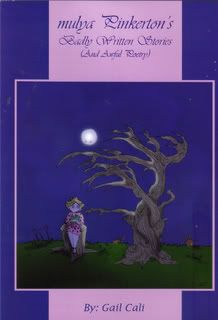
mulya Pinkerton's Badly Written Stories (and Awful Poetry) by Gail Cali.


http://www.lulu.com/content/5866542

This book, written by the admittedly imaginary mulya Pinkerton, is a delightful romp in literary nonsense. It is nothing more than what it claims to be, which is wonderfully uninhibited journaling about things such as werechildren, pickles, and the undoing of reality. The humor is engaging and a bit dark, with shades of Shel Silverstein, Douglas Adams, Walter Moers. (Another reviewer mentioned, of course, Lewis Carroll, and I have to agree.) I thoroughly enjoyed it, and give it bonus points for using the word "isotropy" in a poem.


Wednesday, April 22, 2009

re The Morgaine Saga

Sort of "found poetry", and yet not really true "found poetry".

What I usually do is, I open a book and try to make a poem out of the words nearest the left margin (or the right margin, or the center of the page, depending on my mood; these are all from the left margin).

I wrote these for April being National Poetry Month.

I.

Considered it,
man compelled at once-
no.

Take her orders and the door.
It closed questioningly.

He felt sick- and yet-
there, beginnings remain.

page 65 of The Morgaine Saga (omnibus edition)
Gate of Ivrel by C.J. Cherryh


II.

There-
deep places
often overgrown
in
passage-
the hills,
born to this land
without sleep and rest,
lag by several lengths
at dusk,
against the
sprawling and untidy
maps.

To learn the names
of the land
where spring flowed,
drink
from her hand,
drinking them.

He nodded,
and
little
came
down.

page 413 of the Omnibus edition The Morgaine Saga
Well of Shiuan by C.J. Cherryh


III.

Song was neither outcry nor sheltering.
Do not Lord now if we help that one left-
only sin and his kinfolk.

The hall was long and restless,
wings making fire at last,
quiet without armor,
the hour very well organized.

Eyes that had lain on wars came. "Is it?"
"Aye. Answered, known, and may it be."

Fifteen hundred years distressed him.

from page 529 The Morgaine Saga (omnibus edition)
Fires of Azeroth by C.J. Cherryh

Cherryh's The Morgaine Saga (3-1/2 stars)


(Backdating as I read The Morgaine Saga before I read mulya Pinkerton.)


The Morgaine Saga is science fiction-fantasy, and I do not really read a lot of fantasy, esp given that fantasy heroines tend to be decked out in chain mail bikinis or be token playthings. Morgaine, however, is neither. Course she is thought to be a witch, but that is because she is from a distant, technologically advanced world. The last surviving member of the task force sent out to close interplanetary Gates (portals/wormholes) which are undermining the fabric of the universe, Morgaine is stranded on a planet where feudal rules prevail. She proves quite capable of playing by these rules, even though the odds are much against her and her liegeman, Vanye.


The trilogy could just as well be titled The Vanye Saga, as it is told from Vanye's point of view and Vanye is a most interesting and sympathetic character. At first he is horrified that he has unwittingly entered into an unconditional allegiance to Morgaine, whom he views as a not-human who wields terrible magic. He is caught in a bind- break his oath to her, which would mean the damnation of his soul for all eternity, or keep his oath to her, which would likely mean the same thing. The situation is not unlike his entire life- such being the lot of a bastard son born of a powerful lord and a very unwilling, equally powerful lady of an enemy house. Cursed and cast out for killing his half brother in self-defense, Vanye choses to see his year commitment to Morgaine as a chance at atonement. Once the year is up, he is a free man with a clean slate- he can actually live a life free of the worst of his stigmas.


During the break-neck, miserable struggle for survival that Morgaine's mission becomes, however, Vanye becomes aware of the awful burden on her and of the secret she carries that could destroy his world and will most certainly destroy her. He realizes that she is oath-bound to something much larger than he has ever known, something beyond the pale of the medieval powers and alliances and forces that want desperately to have it for themselves. Something that another person from far away has come to gain, as well.


The trilogy's first book, Gate of Ivrel, is set in Vanye's world and time. Well of Shiuan follows up events, hundreds of years distant on a quite different world(and yet but a momentary hop for Morgaine and Vanye), which have carried over through the gate and become hopelessly entangled with local politics and a looming natural disaster. This most directly spills over into Fires of Azeroth as thousands flee through the gate into yet another world, seeking to take it and the unlimited, unreliable, and unstable powers of the gates for themselves.


The character development is nicely done if not brilliant, the action fast-paced, the plot believable, and the resolution satisfying. Early Cherryh, she's still learning, but quite enjoyable.


Wednesday, April 8, 2009

oooh, another one came in today:

Set Your Voice Free : How To Get The Singing Or Speaking Voice You Want
Author: Roger Love, Donna Frazier

happy dance

Tuesday, April 7, 2009

Between March 1st and now,

my library (and to-read pile) increased by 9 books:


Camera Politica: The Politics and Ideology of Contemporary Hollywood Film
Author: Michael Ryan, Douglas Kellner


The Bonfire of the Vanities
Author: Tom Wolfe


Memory and Dream
Author: Charles De Lint


The Reverse of the Medal yay! finally
Author: Patrick O’Brian


Afoot and Afield in San Diego County
Author: Jerry Schad


The forest and the sea: A look at the economy of nature and the ecology of man (Time reading program special edition)
Author: Marston Bates


A Perfect Spy
Author: John le Carre


mulya Pinkerton’s Badly Written Stories
Author: Gail Cali
http://www.lulu.com/content/5866542


Early Spring: An Ecologist and Her Children Wake to a Warming World
Author: Amy Seidl


In that same time, I read 5 books:


Literature and the Gods by Roberto Calasso


The OuT-of-Synch Child by Carol Stock Kranowitz


Gate of Ivrel
Well of Shiuan
and
Fires of Azeroth
by C.J. Cherryh


need to read more…

Saturday, March 14, 2009

The Out-of-Sync Child by Carol Stock Kranowitz

The Out-of-Sync Child by Carol Stock Kranowitz 4 minutes ago

The Out-of-Sync Child: Recognizing and Coping with Sensory Integration Dysfunction


Read intro


How Sensory Processing Disorder (Sensory Integration Dysfunction) Affects Learning


I wish there was a book like this when I was growing up. I saw myself on every single page.


I already knew I had sensory processing problems, because some things are just obvious. They didn’t call me the Human Nerve Ending in high school for nothing. I’m incredibly hypersensitive to some things. However, I didn’t realize how undersensitive I am to some things, or how many of my difficulties were tied up with sensory processing. For example, florescent lighting drives my hypersensitive eyes and ears mad, and a half-hour trip to even a quiet, sedate store with those lights can wear me out for the rest of the day. But due to my low body awareness, I have a very high tolerance to (most) pain, and was hardly uncomfortable at all giving birth to my kids. And I knew that the reason I got motion sick so easily (as a kid, just by swinging) was because of my vestibular processing problems, but I didn’t realize that’s also why I have no sense of direction. Etc.


I also didn’t realize how many of my difficulties came from not being able to use my senses together well. I have great visual skills, and yet my depth perception is pathetic, even non-existent. That’s because my vestibular and proprioreceptive senses are not processed well. In order to have depth-perception, to know how far away things are, you need a good sense of body awareness and where you are in relation to gravity first of all- and I don’t have a good sense of that.


And I knew I had dyspraxia, but I didn’t realize how pervasive it really was. A lot of things I just wrote off as inattention on my part (or “brain spazzing”) could be explained by dyspraxia. (Everything from spoonerisms- “runny babbit”- to pulling ketchup out of the refrigerator, when you wanted milk for your cereal.)


My kids’ sensory problems are worse than mine, and by learning from their therapists I have seen improvement in both them and me. In fact, since I started teaching the kids myself, we have been doing an enormous amount of sensory work, and the results have been phenomenal. I see another post shaping up on that alone…


Whether you call it Sensory Integrative Disorder, Sensory Integrative Dysfunction, Sensory Processing Disorder, or just plain “indigestion of the brain”, The Out-Of-Sync Child is not only a good introduction to the problem, but is considered the unofficial bible on the subject. If any of the examples sound familiar to you, I recommend you check it out. There is treatment, and it is simple and effective. You may never be “cured”, but there is definite improvement. After living my entire life being frustrated, confused, depressed, and feeling clumsy, erratic, ineffectual, hopeless, and pathetic, I can tell you that the worst complications of SPD are its negative effects on your self-esteem and self-identity.


Knowing what the hell is going on in your head is a huge relief, and being able to do something about it is uplifting and empowering, whether it’s for you or your child.


Sunday, March 8, 2009

The Spell of the Sensuous, and, Literature and the Gods

I would say that Literature and the Gods picks up on, and goes a similar direction with, a main premise of The Spell of the Sensuous: humanity doesn't live in the real world anymore. We live in a world of our own construction, based on ideas we came up with to help us deal with, not understand, the real world. Those ideas grew to beliefs to world views and into a world(s) of their own. And they change how we perceive and evaluate everything around us; so much so that we interpret them to be truer than the reality we physically live in.

Calasso says we've written off the myths of our past, but myth still controls us: we just live in a new myth now. On page 71, he quotes Nietzsche's piece "How the 'Real World' Ended up as Fable" from "Twilight of the Gods". I'm tempted to type the whole thing in here... I might do that later...

It's a strange and surprising thing, to take a good look around after reading those books.

One thing that really sticks in my mind is on page 36 of Literature and the Gods. Calasso quotes Leopardi on reason as a lethal power that "renders all the objects to which it turns its attention small and vile and empty, destroys the great and the beautiful and even, as it were, existence itself, and thus is the true mother and cause of nothingness, so that the more it grows, the smaller things get."

But if you call it Reason, it must be reasonable, right?

Monday, March 2, 2009

Literature and the Gods by Calasso

I will be the first to admit that when I read something that is complicated, or about which I know very little, I chunk through it. I just read it anyway, and worry about understanding it later. I had to do a bit of this with Literature and the Gods, because I am not very familiar with the 19th century French poetry scene. I’ve heard of Baudelaire, of course, but hadn’t thought of him in ages, except that EM rented Groundhog Day about a week ago, and the movie mentions Baudelaire। ;)


I’m sure some of this book went right over my head। I’m fine with that. At least now it’s stored in my subconscious somewhere, and if I come across a related theme/trope/discussion later, I hopefully will think, Oh, that sounds like something from Literature and the Gods! And go look it up again. Or, I’ll read some of the works discussed in the book, and then whole sections of the book will be lit up with a sudden understanding of what Calasso was saying.


I’ve never understood why people think they have to understand everything the first time, or get it perfectly right before they move on. Oh, sure, I’m horribly guilty of that when it comes to
writing lol, but not when I’m reading or doing math or something else. It’s fine to have a sketchy comprehension that becomes more detailed and thorough over time, and then when you have a better understanding of it all, you can revisit your first thoughts and see how your thinking has progressed. Some of the first thoughts when you’re learning something are very helpful as they tend to be more original and less pigeonholed than those later on।

Anyway. Even though I haven’t read some of the French poets discussed in Literature and the Gods yet ;), I have read/am familiar with the Greek and German thinkers mentioned। Nietzsche, god bless him, comes up fairly frequently. This is not at all surprising, as the subject of the book is literature and myth, gods, and the divine, and how that relationship has changed over time. Which is intimately related to how the relationship between myth and people have changed over time as well.


I am very interested in such themes. In fact, at one point रीडिंग this I thought: whereas EM is musically inclined, I am mythically inclined. It’s part of why I enjoy C.J. Cherryh’s Rusalka trilogy and Neil Gaiman’s American Gods so much। The theme of myth and belief:


“People believe, thought Shadow. It’s what people do. They believe. And then they will not take responsibility for their beliefs; they conjure things, and do not trust the conjurations. People populate the darkness; with ghosts, with gods, with electrons, with tales. People imagine, and people believe; and it is that belief, that rock-solid belief, that makes things happen.”
[page 536, American Gods]


I’m afraid I have not fully digested the contents of his book enough to give you a play-by-play account of it। I am sure I have missed some points, and on others I gave the author the benefit of the doubt/my own ignorance. And yet I am surely inspired to learn more, to read more, and to say: Calasso is a delight to read, even if it takes a while to get used to his generous style. His easy wit and ready, familiar knowledge of his sources enables him to weave together a brilliant narrative of how humanity’s innate ability and overwhelming tendency to embellish and even invent the world around us has changed since the time of the ancients (and their gods), and yet not changed as much as we might have thought, and, indeed, how unaware we are of the power that myth and belief have over us.


The very idea that mythology is something one invents suggests an unpardonable arrogance, as if myth were at our beck and call. Rather, it is we, the will of each and every one of us, that are at the beck and call of myth.
[46, Literature and the Gods]


“In a remote corner of the sparkling universe that stretches away across infinite solar systems, there was once a star where some clever animals invented knowledge. It was the most arrogant and deceitful minute in ‘the history of the world’: but it lasted only a minute. Nature breathed in and out just a few times, then the star hardened and the clever animals had to die.”
[Nietzsche quoted on page 184 of Literature and the Gods]


I say, it is common knowledge that little girls in the West are often brought up on fairy tales that ultimately fail them when they mature into womanhood. And yet, boys are told fairy tales, too, of a fundamentally different kind. They are still tales that change what you expect from the world, and therefore what you see, only it never occurs to people that they might not be true. “And this is its supreme triumph, as the supreme aspiration of the Devil is to convince everyone he doesn’t exist। [72, Literature and the Gods]


This book is quite academic in nature, again, fine with me, as I am an academia nut, and is not what most people would think of as a light, breezy read. It requires attention and some sense of adventure and open-mindedness to follow. As early as page 5, Calasso introduces ancient ideas of “god” as a predicative (one shade away from proclaiming “god” to be a verb), and goes on to explore “god” as “divinity” where divinity is enmeshed and hidden within everyday reality, and touches on a popular modern interpretation of “god” as a mental event or disease. He presents how literature and verse were seen in some traditions as devotion and an escape from death, how they continued on as servants to and upholders of society, and then how, severed from those strong bonds of society and the myths society created, they became “closer to the underlying ground of our experience” and the myths that create societies. I hope this sentence, this review, still makes sense when I read it again in a month. Towards the end, Calasso discusses how changes in the world changed not only literature and verse and language, but revealed their true natures and their relation to each other (and to the truth). Throughout it all is a marvelous discussion of some of the writers involved in this process and their journeys to find the divine. I am especially off to seek out Stephane Mallarme। And, of course, absolute literature itself:

irresponsible, metamorphic, carrying no identity card that a desk sergeant might examine, deceptive in its tone..., and, finally, subject to no authority.
[181, Literature and the Gods]


In which case it might be a good idea to end with a reminder:

“God,” Pyetr said. “I’m going to go talk to my horse. Books make you crazy, you know.” A motion at his head. “Thinking all those crooked little marks mean real things, that’s not sane, you know.” He waved the same hand toward the front door. “Out there is real. Don’t lose track of that.”
[42, Chernevog]

Tuesday, February 17, 2009

Fair Game by Valerie Plame Wilson & Courage For The Earth edited by Peter Matthiessen

Fair Game: How a Top CIA Agent Was Betrayed by Her Own Government

This was a surprisingly quick and easy read, made even quicker by the large swaths of blacked-out writing representing the text the CIA would not let Plame put into print in her own name. The afterword by Laura Rozen contains all the information blacked-out of Plame’s account, and demonstrates that it was all in the public domain. Plame is just telling a (more personable) side of the story which everyone already knows.

It is rather disturbing to think the Office of the President would blame a faulty military strategy on the “failure” of the intelligence community in general. How is that supposed to reassure the American people? Well, the President’s plan didn’t work, but that was nobody knew what they were talking about. ? It’s disturbing that this is the plan they came up with, and it’s even more disturbing how they tried to silence their detractors by actively undermining agents in the field and therefore the intelligence community itself. What part of the system did they not understand? Or, more likely, what part of the system did they think they were so powerful that they didn’t even need anymore?

I wish I could say I was surprised much by the government fiasco in general, but, not really. Those in charge, those few with power, often twist and distort things until it matches up with their version of reality. Which brings us to:

Courage for the Earth: Writers, Scientists, and Activists Celebrate the Life and Writing of Rachel Carson

This is a brilliant collection of essays and excerpts on one of the most important writers of literature of the 20th century. She is most famous for Silent Spring, which brought into public awareness the origins, dangers, and careless wide-spread use of pesticides, and which prompted brutal and personal attacks on her from all sides of government, industry, and the scientific community. The facts of the matter vindicated her and her firm resolve to make a stand, and thankfully the facts did come out before her death by cancer two years after Silent Spring was published.

But she was even more than the author of Silent Spring. She was one of the writers who made science accessible to the average person, who made it interesting and relevant. Her trilogy on ocean life (Under the Sea-Wind, The Sea Around Us, and The Edge of the Sea) were incredibly popular. She was a talented writer who refused to think of science as something in a little box on the shelf to be taken down and used during experiments. Science was part of our everyday life.

She said that “the aim of science is to discover and illuminate truth. And that, I take it, is the aim of literature, whether biography or history or fiction. It seems to me, then, that there can be no separate literature of science.”

She also refused to think of spirituality as something in a little box on the shelf to be taken down and used during church. She saw no need for science or modern life to be sterile and mechanical.

“The winds, the sea, and the moving tides are what they are. If there is wonder and beauty and majesty in them, science will discover these qualities. If they are not there, science cannot create them. If there is poetry in my book about the sea, it is not because I deliberately put it in there, but because no one could write truthfully about the sea and leave out the poetry.”

The essays in this collection show her influence on the world, person by person. Today many people who do not even know the name Rachel Carson believe in what she stood for and have taken her message to heart. She helped make the nation (and the world) aware of us all “as a very tiny part of a vast and incredible universe, a universe that is distinguished above all else by a mysterious and wonderful unity that we flout at our peril.” But she knew it wouldn’t be that simple, and, after all these years, we are still not fully awake. Oh, reading this book was very emotional for me. Many of her warnings- many of her scientifically documented cases of the poisons in our air, water, food, and environment- have been pushed aside, swept under the rug, covered up by those who don’t want to hear it, those who don’t want us to think about it, because they make too much money from the way things are. Try to go through the day without ingesting bleach, plastic, or pharmaceuticals. It should be easy, right? And yet, no. We are doing it everyday, and we aren’t even aware of the fact. It is hardly safe or sane to continue on this path. So why are we still on it, after almost 50 years?

If there is any hope for us at all, it may well come from a wish Rachel Carson made for the world herself,

that every child in the world have “a sense of wonder so indestructible that it would last throughout life, as an unfailing antidote against the boredom and disenchantments of later years, the sterile preoccupation with things that are artificial, the alienation from the sources of our strength.”

I, too, wish that we reconnect with the real, living world around us, and see through our illusions of independent power and grandeur, and be made whole again by the very world we have demeaned and seem hell-bent on destroying. Let us understand what our everyday choices mean, let us choose our future more carefully. Let us have courage for the earth.

There is a whole trove of other books mentioned in this book that I need to go find now. And I want to reread her work again as well.

Tuesday, January 20, 2009

right now I am reading

Spirituality for the Skeptic: The Thoughtful Love of Life

and

Courage for the Earth

don’t you like how the titles go together?

brief mentions of relatively recent reads, and commentary on A Short, Sharp Shock by Kim Stanley Robinson

brief mentions of relatively recent reads, and commentary on A Short, Sharp Shock by Kim Stanley Robinson. 6 days ago

Let’s see… I know I’ve read Eragon, Cloud’s Rider by C.J. Cherryh, and oh yes The Spell of the Sensuous by David Abram (5 stars! and a longer review later, probably after discussion with Kalibebti, who is reading it now). Eragon is great writing for a fifteen year old. Cloud’s Rider (sequel to Rider at the Gate) is interesting and compelling… if you can get past the set-up of the story, which drove me crazy.

me: “What? Don’t do that! You know what will happen if you do that! Oh well…”

That kills me.


That is why I can’t watch horror movies.

me: No, DON’T go investigate that growling sound outside your window on the full moon, carrying nothing but a plastic flashlight and/or a fly swatter. Hello??? Recent slayings in the neighborhood???”


But the rest of the story is so good… I think I’d give it a 3.5.

I finished A Short, Sharp Shock by Kim Stanley Robinson last night, and I have to wonder… Is it like The Wizard of Oz, full of symbolic political and social commentary (that I didn’t pick up on)? Is it a side story from another novel of his (that I haven’t read yet), that he explores more fully here? Or what?

It reminds me of a certain French movie I saw (I’m drawing a blank on the title) where some sort of apocalytpic collapse of civilization had occurred (you never find out what), and the main characters spend the entire movie trying to get to a safe place, interacting with other people as they come across them, and then the movie just ends, with absolutely nothing resolved and no one the wiser. Only, the movie was set in France. ;)

If it is a comment on the absurdity of life, I have to say I much prefer The Trial. That was just as bizarre in many respects, and yet I enjoyed it greatly. This book, I have no idea why anybody did anything that they did (except when Thel and co tried to reunite or escape murderous foes). SSS seemed very formulaic and convenient; the antagonists did what they did because it was what the author wanted them to do. I have to say I don’t think I cared for it very much at all. So, maybe I am missing something?

I really loved his Mars trilogy (4-5), which was very different, but I wasn’t expecting anything like that in this little book. Still, I wasn’t expecting what I read, either.

As my understanding of it is right now, I would give A Short, Sharp Shock two stars. and I haven’t rated anything that low since The Life of Pi.

:\

the allure of Cherryh's Assassins

those of you who don’t know what I’m talking about, god bless you. those of you who do know what I’m talking about, god bless you.

I am quite taken with C.J. Cherryh’s Foreigner series, space opera though it may be, for several reasons. one is the main character, Bren, who is an ENFJ and therefore very similar to me sometimes. so is his situation, at least symbolically. but one very important reason is the Assassin’s Guild.

and WHY, you ask, WHY?

part of it is the alien other. but, after struggling to define it, I came across a passage I had marked wherein Bren explains why the assassins fascinate him, and it’s perfect. Bren and I do have a lot in common.

I just feel like quoting it today:

There seemed a quality to people the Assassin’s Guild let in and licensed. He didn’t know what they had in common, except perhaps an integrity that touched chords in his shades -of -gray soul, a feeling, maybe, that one could do things that rattled one’s conscience to the walls and foundations and still – still own a sense of equilibrium.

Banichi was going to teach him about doors. It wasn’t what he wanted to learn from Banichi. What he wanted to understand was something far more basic. Invader, 388


there are other books I’ve read since my last entry, btw, I just haven’t logged them in yet. I’m sooo behind.

Sunday, November 23, 2008

The Far Side of the World, by Patrick O'Brian: 5 stars

I have grown to realize that everything I am reading these days just gets sucked down immediately under the surface of my being, down into the bubbly depths, to be more fully digested and understood. My reading appetite is insatiable whereas I find any thoughts I have on what I’ve just read rather unformed, even though I’ve finished reading it.

I have decided to blame it on the changing of the seasons. Now that the harvest is over, it might be a long winter before I start writing anything much useful in the spring.

Tuesday, November 18, 2008

Treason's Harbour by Patrick O'Brian: 5 stars

finished this one last night.

started the next in the series, The Far Side Of The World, this afternoon.

I’ve decided not to review or try and summarize the books in this series the first time around. but they are AWESOME

Friday, November 14, 2008

About Love by Robert Solomon (5 stars)

it has taken me over a month to read this book. why? every page, every half-page, every sentence of this book made me stop and think. and no, I wasn’t looking up all the words to see what he meant- the language is precise and candid. none of the puritanical jargon one expects from academia although he does mention phenomenology , and none of the oversimplified patter often offered up by relationship gurus or other love pundits, either. just a clear, sane voice, illuminating love in a way that reveals both new things and things you already knew but took for granted. and, by illuminating love, it illuminated everything from conversations I’ve had to whole portions of my life in a new light.

it is a fabulous read. a life-improving read, no doubt.

I am not sure I can sum it up nicely… the book builds from the first page to the very end, and there are so many important details. I will try maybe quoting bits and pieces, to just give you a brief, kaleidoscope idea of it all. although looking at all the poor pages I dogeared for that purpose, I doubt I can quote from all of them.

oh, and yes, I must point out, this book is on romantic love. he does briefly contrast it against other types of love, but he focuses on what romantic love is and how/why it works.

...[L]ove is not a mysterious “union” of two otherwise separate and isolated selves but rather a special instance of the mutually-defined creation of selves. Who and how we love ultimately determines what we are. (24)

We too easily tend to conclude that great feeling constitutes love, and the greater the feeling, even if incapacitating, the greater the love. But this is dangerous nonsense. Feelings follow, they do not lead the psyche. They are the body’s attempt to keep up with the mind and its intentions. Feelings are not the whole nor even the measure of love. (81)

Perhaps this is also the place to say something about the familiar query, whether it is better to love or be loved. My answer, very quickly, is that to be loved is not an emotion or an experience at all. Without loving, it is at best a compliment or a convenience, often an unwanted obligation, and at worst a burden or a curse. It is loving that counts, and then being loved is the most important thing in the world. (85)

It is tragic and absurd that our idealized storybook romance should be so different and so detached from the real story of love and our conception of love should, consequently, be so divided into two wholly separate parts, one romantic and exciting but unrealistic and the other a dull tale of domesticity and endurance, devoid of the excitement that many of us now insist upon to make life worthwhile… The romantic story is all about the thrill of newfound love, but it is so filled with suspense and excitement or pathos that it cannot bear the weight of the future. “Forever” is thus an evasion of time rather than a celebration of it. The infinitely less romantic part of the story is about the formation and working out of a partnership, legally defined as such by marriage. It is a topic fit for accountants, advisers and counselors, in which the market virtues of honest and fair exchange and the business skills of negotiation and compromise are of great value… In other words, first there is the thrill, then there is the coping. (100-1)

Fantasy is an extension, an embellishment, an enrichment of reality, not an alternative to it. Fantasy should be opposed only to that dull, practical planning that is too often rationalized as “realism.” Love, like music, lives in the imagination, but it is no less real for that. (163)

The essential thing to remember is that it is the identity itself that is crucial to love and its lasting and not one or two of the dimensions that may contribute to it. Sex may hold love together for a certain period but then get superseded by less passionate shared experiences and roles which nevertheless bind love with no less success, and it is tragic that we should so often confine our definitions of love to sexual passion and ignore the fact that the bond of love may be equally served by any number of shared and reciprocal activities and attitudes. (238)

We have said a great deal about the creation of self, but the simplest formula for self-creation is that, insofar as we create ourselves, we do so by caring… Life has meaning not because of what we have or what we know or what we are “in ourselves” but because we care about something. (260-1)

Intimacy is an experience of mutual availability. It is not just openness of expression but an openness of the self to share and to change. (278)

The need to rethink the rules of love and reinvent love for ourselves is in fact one of the most powerful inspirations of love. Love thrives by being thought about; it is not just a feeling that goes on its way whether we pay attention to it or not. .... Love must be reinvented, but it is being so right now, by all of us, two at a time. (349)


I am sad all over again that I never got to meet him. I had the chance but as usual didn’t realize how short time is for us. I wish he were still in the world; it needs people like him, I think.

Saturday, September 13, 2008

ब्रेइफ्ली

The Pursuit of Loneliness 8/15-8/24
The Ionian Mission 8/25-8/30
The Vulnerable Observer8/31-9/02
Weapons of Choice 9/03-9/06

started Kinship and Gender on 9/07